


Page 39 - 2000 ICELAND
P. 39
born Icelanders are descendants of 38,000 survivors of the great famine of
            the late 1700s caused by huge volcanic eruptions which blanketed the earth,

            killed many plants, animals and people, and then plunged Iceland into a sort
            of mini-nuclear winter thereby causing devastating famine.


            Many  people  emigrated  at  that  time  to

            Europe (primarily Denmark and the UK) and
            to  the  United  States  to  escape  the  human

            and  ecological  disaster.      So  this  event  was

            like  Ireland’s  great  Potato  Famine.    There
            were other unhappy circumstances, such as

            the  other  European  nations’  inability  or
            unwillingness to help the starving Icelanders.

            Even  Denmark,  which  ostensibly  ruled  Iceland  at  that  time,  ignored  the
            plight  of  its  people.    Icelanders  were  so  poor  they  did  not  even  own  the

            shipping  vessels  which  carried  their  products  to  Denmark.    The  Danes

            owned them and did not send them to relieve the famine.


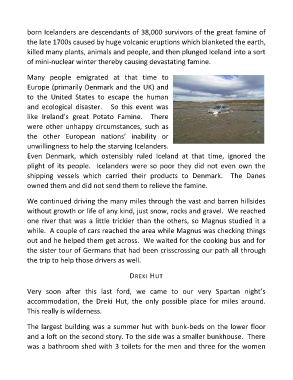
            We continued driving the many miles through the vast and barren hillsides
            without growth or life of any kind, just snow, rocks and gravel.  We reached

            one river that was a little trickier than the others, so Magnus studied it a
            while.  A couple of cars reached the area while Magnus was checking things

            out and he helped them get across.  We waited for the cooking bus and for
            the sister tour of Germans that had been crisscrossing our path all through

            the trip to help those drivers as well.


                                                       DREKI HUT


            Very  soon  after  this  last  ford,  we  came  to  our  very  Spartan  night’s

            accommodation,  the  Dreki  Hut,  the  only  possible  place  for  miles  around.
            This really is wilderness.


            The largest building was a summer hut with bunk-beds on the lower floor

            and a loft on the second story. To the side was a smaller bunkhouse.  There
            was a bathroom shed with 3 toilets for the men and three for the women

