


Page 22 - statbility for masters and mates
P. 22
10 Ship Stability for Masters and Mates
The centre of gravity of a homogeneous body is at its geometrical centre. Thus the centre of gravity of a homogeneous rectangular block is half-way along its length, half-way across its breadth and at half its depth.
Let us now consider the effect on the centre of gravity of a body when the distribution of mass within the body is changed.
Effect of removing or discharging mass
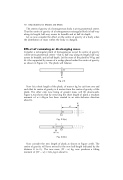
Consider a rectangular plank of homogeneous wood. Its centre of gravity will be at its geometrical centre ± that is, half-way along its length, half-way across its breadth, and at half depth. Let the mass of the plank be W kg and let it be supported by means of a wedge placed under the centre of gravity as shown in Figure 2.2. The plank will balance.
Fig. 2.2
Now let a short length of the plank, of mass w kg, be cut from one end such that its centre of gravity is d metres from the centre of gravity of the plank. The other end, now being of greater mass, will tilt downwards. Figure 2.3(a) shows that by removing the short length of plank a resultant moment of w dkgm has been created in an anti-clockwise direction about G.
Fig. 2.3(a)
Fig. 2.3(b)
Now consider the new length of plank as shown in Figure 2.3(b). The centre of gravity will have moved to the new half-length indicated by the distance G to G1. The new mass, (W w) kg, now produces a tilting moment of  W w  GG1 kgm about G.


