


Page 24 - statbility for masters and mates
P. 24
12 Ship Stability for Masters and Mates
In Figure 2.4(b), the mass is vertically above G and the ship's centre of gravity will move directly downwards to G1.
In Figure 2.4(c), the mass is directly to starboard of G and the ship's centre of gravity will move directly to port from G to G1.
In Figure 2.4(d), the mass is below and to port of G, and the ship's centre of gravity will move upwards and to starboard.
In each case:
GG1   w d metres Final displacement
Effect of adding or loading mass
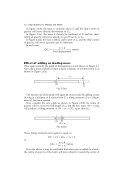
Once again consider the plank of homogeneous wood shown in Figure 2.2. Now add a piece of plank of mass w kg at a distance of d metres from G as shown in Figure 2.5(a).
Fig. 2.5(a)
The heavier end of the plank will again tilt downwards. By adding a mass of wkg at a distance of d metres from G a tilting moment of w dkgm. about G has been created.
Now consider the new plank as shown in Figure 2.5(b). Its centre of gravity will be at its new half-length (G1), and the new mass, (W   w) kg, will produce a tilting moment of (W   w)   GG1 kg m about G.
Fig. 2.5(b)
These tilting moments must again be equal, i.e.
 W w  GG1  w d GG1   w d metres
From the above it may be concluded that when mass is added to a body, the centre of gravity of the body will move directly towards the centre of
or
W w


