


Page 34 - statbility for masters and mates
P. 34
Chapter 4
Laws of ¯otation
Archimedes' Principle states that when a body is wholly or partially immersed in a ¯uid it appears to suffer a loss in mass equal to the mass of the ¯uid it displaces.
The mass density of fresh water is 1000 kg per cu. m. Therefore, when a body is immersed in fresh water it will appear to suffer a loss in mass of 1000 kg for every 1 cu. m of water it displaces.
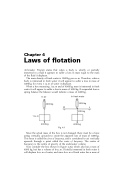
When a box measuring 1 cu. m and of 4000 kg mass is immersed in fresh water it will appear to suffer a loss in mass of 1000 kg. If suspended from a spring balance the balance would indicate a mass of 3000 kg.
Fig. 4.1
Since the actual mass of the box is not changed, there must be a force acting vertically upwards to create the apparent loss of mass of 1000 kg. This force is called the force of buoyancy, and is considered to act vertically upwards through a point called the centre of buoyancy. The centre of buoyancy is the centre of gravity of the underwater volume.
Now consider the box shown in Figure 4.2(a) which also has a mass of 4000 kg, but has a volume of 8 cu. m. If totally immersed in fresh water it will displace 8 cu. m of water, and since 8 cu. m of fresh water has a mass of


