


Page 35 - statbility for masters and mates
P. 35
Laws of ¯otation 23
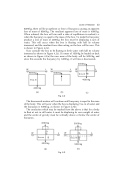
8000 kg, there will be an upthrust or force of buoyancy causing an apparent loss of mass of 8000 kg. The resultant apparent loss of mass is 4000 kg. When released, the box will rise until a state of equilibrium is reached, i.e. when the buoyancy is equal to the mass of the box. To make the buoyancy produce a loss of mass of 4000kg the box must be displacing 4cum of water. This will occur when the box is ¯oating with half its volume immersed, and the resultant force then acting on the box will be zero. This is shown in Figure 4.2(c).
Now consider the box to be ¯oating in fresh water with half its volume immersed as shown in Figure 4.2(c). If a mass of 1000 kg be loaded on deck as shown in Figure 4.3(a) the new mass of the body will be 5000 kg, and since this exceeds the buoyancy by 1000 kg, it will move downwards.
Fig. 4.2
The downwards motion will continue until buoyancy is equal to the mass of the body. This will occur when the box is displacing 5 cu. m of water and the buoyancy is 5000 kg, as shown in Figure 4.3(b).
The conclusion which may be reached from the above is that for a body to ¯oat at rest in still water, it must be displacing its own weight of water and the centre of gravity must be vertically above or below the centre of buoyancy.
Fig. 4.3


