


Page 353 - statbility for masters and mates
P. 353
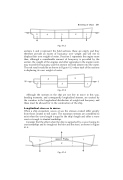
Fig. 41.2
sections 2 and 4 represent the hold sections, these are empty and they therefore provide an excess of buoyancy over weight and will rise to displace their own weight of water. If section 3 represents the engine room then, although a considerable amount of buoyancy is provided by the section, the weight of the engines and other apparatus in the engine room, may exceed the buoyancy and this section will sink deeper into the water. The nett result would be as shown in Figure 41.3 where each of the sections is displacing its own weight of water.
Fig. 41.3
Although the sections in the ship are not free to move in this way, bending moments, and consequently longitudinal stresses, are created by the variation in the longitudinal distribution of weight and buoyancy and these must be allowed for in the construction of the ship.
Longitudinal stresses in waves
When a ship encounters waves at sea the stresses created differ greatly from those created in still water. The maximum stresses are considered to exist when the wave length is equal to the ship's length and either a wave crest or trough is situated amidships.
Consider ®rst the effect when the ship is supported by a wave having its crest amidships and its troughs at the bow and the stern, as shown in Figure 41.4.
Fig. 41.4
Bending of ships 341


