


Page 354 - statbility for masters and mates
P. 354
342 Ship Stability for Masters and Mates
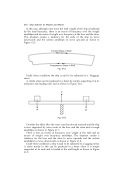
In this case, although once more the total weight of the ship is balanced by the total buoyancy, there is an excess of buoyancy over the weight amidships and an excess of weight over buoyancy at the bow and the stern. This situation creates a tendency for the ends of the ship to move downwards and the section amidships to move upwards as shown in Figure 41.5.
Fig. 41.5
Under these conditions the ship is said to be subjected to a `Hogging' stress.
A similar stress can be produced in a beam by simply supporting it at its mid-point and loading each end as shown in Figure 41.6.
Fig. 41.6
Consider the effect after the wave crest has moved onwards and the ship is now supported by wave crests at the bow and the stern and a trough amidships as shown in Figure 41.7.
There is now an excess of buoyancy over weight at the ends and an excess of weight over buoyancy amidships. The situation creates a tendency for the bow and the stern to move upwards and the section amidships to move downwards as shown in Figure 41.8.
Under these conditions a ship is said to be subjected to a sagging stress. A stress similar to this can be produced in a beam when it is simply supported at its ends and is loaded at the mid-length as shown in Figure 41.9.


