


Page 16 - Alaska A & P Primer
P. 16
3.1 The Cell Membrane
3.2 The Cytoplasm and Cellular Organelles
3.1 OBJECTIVES
1. Explain the major features and properties of the cell membrane
3.2 OBJECTIVES
1. Explain the three components of the cytoskeleton, including their composition and functions
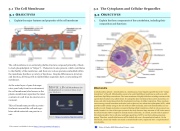
The cell membrane is an extremely pliable structure composed primarily of back- to-back phospholipids (a “bilayer”). Cholesterol is also present, which contributes to the fluidity of the membrane, and there are various proteins embedded within the membrane that have a variety of functions. Despite differences in structure and function, all living cells in multicellular organisms have a surrounding cell membrane.
As the outer layer of your skin sepa- rates your body from its environment, the cell membrane (also known as the plasma membrane) separates the inner contents of a cell from its exterior envi- ronment.
This cell membrane provides a protec- tivebarrier around the cell and regu- lates which materials can pass in or out.
MOVIE 1.8 Cell Membrane In- troduction 8:51 minutes Khan Acad- emy Medicine
Watch: https://youtu.be/QpcACa39YtA
Mitochondria
A mitochondrion (plural = mitochondria) is a membranous, bean-shaped organelle that is the “energy transformer” of the cell. Mitochondria consist of an outer lipid bilayer membrane as well as an addi- tional inner lipid bilayer membrane. The inner membrane is highly folded into winding structures with a great deal of surface area, called cristae. It is along this inner membrane that a series of proteins, en- zymes, and other molecules perform the biochemical reactions of cellular respiration. These reactions convert energy stored in nutrient molecules (such as glucose) into adenosine triphosphate (ATP), which provides usable cellular energy to the cell. Cells use ATP constantly, and so the mitochondria are con- stantly at work. Oxygen molecules are required during cellular respiration, which is why you must con- stantly breathe it in. One of the organ systems in the body that uses huge amounts of ATP is the muscu- lar system because ATP is required to sustain muscle contraction. As a result, muscle cells are packed full of mitochondria. Nerve cells also need large quantities of ATP to run their sodium-potassium pumps. Therefore, an individual neuron will be loaded with over a thousand mitochondria. On the other hand, a bone cell, which is not nearly as metabolically-active, might only have a couple hundred mitochondria.
This content is available for free at https://cnx.org/content/col11496/1.7
State of Alaska EMS Education Primer - 2016
15


