


Page 103 - Bespoke Issue
P. 103
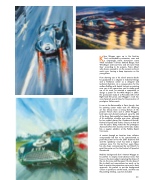
  Klaus Wagger grew up in the Austrian Tirol, surrounded by mountains, cows and a surprisingly active motorsport scene
which included F1 drivers Gehard Berger, Karl Wendlinger and local hero and all round ‘Bad Guy’ according to his parents, Franz Albert who always seemed to run the noisiest and most exotic cars, leaving a deep impression on the young Klaus.
From drawing cars in his school exercise books he graduated to a degree in Industrial Design and a freelance career as a designer and technical illustrator. As a compensation for the endless  ddling with details he kept up painting race cars in his spare time, and to make good use of his work, he entered a competition to design a poster for the Mille Miglia in 2000. His spectacular study of a Mercedes SSK in full  ight took  rst prize, and Wagger’s work has since featured several times for the promotion of prestigious Italian events.
It was at the Retromobile in Paris though, that his painting career really took off. Motoring art has always been a strong feature of this premier French show and in 2002 Wagger’s bold style and vibrant brushwork were the talk of the show. Retromobile has been the mainstay of his exhibition schedule ever since, although he has added places like Goodwood Revival, Festival of Speed and Techno Classica to that list over the years. Being voted into the prestigious Automotive Fine Arts Society in 2013 also makes him a regular exhibitor at the Pebble Beach Concourse.
A contact through an Austrian Lotus collector unexpectedly led him to be commissioned to paint the poster art for the 2007 Daytona 500 and the speedway circuit has been a regular customer since. For the last four years Klaus has also been commissioned by Lord March to paint the poster art for the Festival of Speed at Goodwood.
Realistic backgrounds don’t interest Wagger as he prefers to employ bold abstract tones that focus on the main subject capturing the drama of the car, the noise and the speed. He also doesn’t like to sketch out compositions too much, as he feels it restricts the expressive route and a fresh approach. He prefers to put the background colours in quickly to set the mood, and then see the painting develop, surprises included.
 103


