


Page 174 - Corporate Finance PDF Final new link
P. 174
NPP


                  174                               Corporate Finance                      BRILLIANT’S


                      7. Embedded option: An embedded op-         7. Eå~oS>oS>  Am°ßeZ…  EH$  Eå~oS>oS>  Am°ßeZ  EH$
                  tion is a component of a financial bond or other  ’$m¶Z|{e¶b ~m§S> ¶m Aݶ {g³¶mo[aQ>r H$m EH$ KQ>H$ h¡
                  security, and usually provides the bondholder
                                                              VWm àm¶… ~m§S> hmoëS>a ¶m Bí¶yAa H$mo Aݶ nj Ho$ {dê$Õ
                  or  the  issuer  the  right  to  take  some  action
                                                              H$moB© E³eZ boZo H$m A{YH$ma àXmZ H$aVm h¡& Am°ße§g Ho$
                  against the other party. There are several types
                  of options that can be embedded into a bond.  H$B© àH$ma h¢ {OÝh| EH$ ~m§S> ‘| Eå~oS>oS> {H$¶m Om gH$Vm h¡&
                  Some common types of bonds with embedded    Eå~oS>oS> Am°ße§g dmbo ~m§S²>g Ho$ Hw$N> gm‘mݶ àH$mam| ‘|
                  options include callable bond, puttable bond,  H$mbo~b ~m§S>, nwQ>o~b ~m§S>, H§$d{Q>©~b ~m§S>, E³gQ>|{S>~b
                  convertible bond, extendible bond, exchange-  ~m§S>, E³gM|Oo~b ~m§S> VWm H¡$ßS> âbmoqQ>J aoQ> ZmoQ> gpå‘{bV
                  able bond, and capped floating rate note. A bond
                  may have several options embedded if they are  h¢& EH$ ~m§S> ‘| H$B© Am°ße§g Eå~oS>oS> hmo gH$Vo h¢ ¶{X do
                  not mutually exclusive.                     nañna E³g³by{gd Zht h¢&
                      8. Rights issue: A rights issue or rights of-  8. amBQ²>g Bí¶y… EH$ amBQ²>g Bí¶y ¶m amBQ²>g Am°’$a
                  fer is a dividend of subscription rights to buy  H§$nZr Ho$ {dÚ‘mZ {g³¶mo[aQ>r hmoëS>g© Ho$ {bE ~Zm¶o J¶o
                  additional securities in a company made to the  EH$ H§$nZr ‘| A{V[a³V {g³¶mo[aQ>rO IarXZo Ho$ {bE
                  company's existing security holders. When the  gpãñH«$ßeZ amBQ²>g  H$m EH$ {S>{dS>|S> h¢& O~ amBQ²>g
                  rights are for equity securities, such as shares,  B{³dQ>r {g³¶mo[aQ>rO O¡go {H$ EH$ n{ãbH$ H§$nZr ‘| eo¶g©
                  in a public company, it is a non-dilutive pro
                                                              Ho$ {bE hmoVo h¢ Vmo ¶h H¡${nQ>b àmá H$aZo H$m EH$ Zm°Z-
                  rata way to raise capital. Rights issues are typi-  S>mBë¶y{Q>d ¶WmZwnmV h¡& amBQ²>g Bí¶y gm‘mݶV… EH$
                  cally  sold  via  a  prospectus  or  prospectus
                                                              àm°ñno³Q²>g ¶m àm°ñno³Q²>g gßbr‘|Q> Ûmam ~oMo OmVo h¢& Omar
                  supplement. With the issued rights, existing
                  security-holders  have  the privilege  to buy  a  {H$¶o J¶o amBQ²>g Ho$ gmW {dÚ‘mZ {g³¶mo[aQ>r hmoëS>g© H$mo
                                                              EH$ gpãñH«$ßeZ Ad{Y Ho$ A§Xa EH$ {ZYm©[aV ‘yë¶ na
                  specified number of new securities from the
                  issuer at a specified price within a subscrip-  Bí¶yAa go Z¶r {g³¶mo[aQ>rO H$s {ZYm©[aV g§»¶m IarXZo
                  tion period. In a public company, a rights issue  H$m A{YH$ma hmoVm h¡& EH$ npãbH$ H§$nZr ‘| EH$ amBQ²>g
                  is a form of public offering (different from most  Bí¶y npãbH$ Am°’$[a¨J H$m EH$ àH$ma h¡ (A{YH$m§e Aݶ
                  other types of public offering, where shares are  npãbH$ Am°’$[a¨J go {^ÝZ hmoVm h¡, Ohm§ eo¶g© Am‘ OZVm
                  issued to the general public).              H$mo Omar {H$¶o OmVo h¢)&

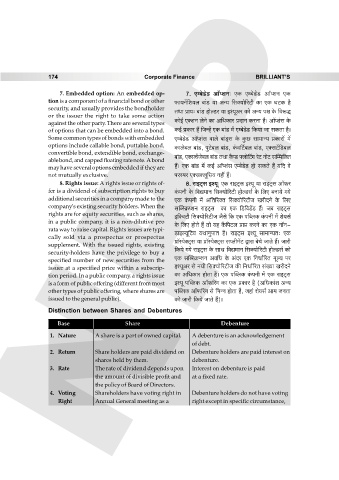
                  Distinction between Shares and Debentures
                         Base                            Share                           Debenture

                   1. Nature      A share is a part of owned capital.  A debenture is an acknowledgement
                                                                    of debt.
                   2. Return      Share holders are paid dividend on  Debenture holders are paid interest on
                                  shares held by them.              debenture.
                   3. Rate        The rate of dividend depends upon  Interest on debenture is paid
                                  the amount of divisible profit and  at a fixed rate.
                                  the policy of Board of Directors.
                   4. Voting      Shareholders have voting right in  Debenture holders do not have voting
                     Right        Annual General meeting as a       right except in specific circumstance,

