


Page 186 - Corporate Finance PDF Final new link
P. 186
NPP


                  186                               Corporate Finance                      BRILLIANT’S


                  tioned, depends upon the value of these shares.  ¶{X ¶o eo¶g© ñQ>m°H$ E³gM|O na {bñQ>oS> hmoVo h¢ Vmo ‘yë¶
                  If these shares are listed on stock exchange, the  ñdrH$m¶© hmoVm h¢ {H$ÝVw ¶{X do {bñQ>oS> Zht h¡ Vmo {H$gr
                  value is acceptable, but if they are not listed,
                                                              {d{Y H$m Cn¶moJ H$aHo$ ‘yë¶ {ZYm©[aV H$aZm hmoVm h¡&
                  then the value is to be determined by using
                  any of the methods.

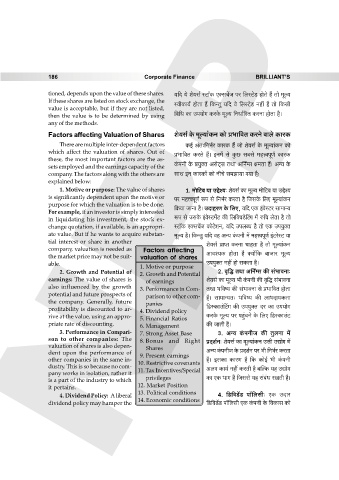
                  Factors affecting Valuation of Shares       eo¶g© Ho$ ‘yë¶m§H$Z H$mo à^m{dV H$aZo dmbo H$maH$
                      There are multiple inter-dependent factors  H$B© A§V…{Z^©a H$maH$ h¢ Omo eo¶g© Ho$ ‘yë¶m§H$Z H$mo
                  which  affect the  valuation of  shares. Out  of  à^m{dV H$aVo h¢& BZ‘| go Hw$N> g~go ‘hÎdnyU© H$maH$
                  these, the most important factors are the as-
                  sets employed and the earnings capacity of the  H§$nZr Ho$ à¶w³V AgoQ²>g VWm A{Zª½g j‘Vm h¢& Aݶ Ho$
                  company. The factors along with the others are  gmW BZ H$maH$m| H$mo ZrMo g‘Pm¶m J¶m h¡…
                  explained below:
                      1. Motive or purpose: The value of shares   1. ‘mo{Q>d ¶m CÔoí¶… eo¶g© H$m ‘yë¶ ‘mo{Q>d ¶m CÔoí¶
                  is significantly dependent upon the motive or  na ‘hÎdnyU© ê$n go {Z^©a H$aVm h¡ {OgHo$ {bE ‘yë¶m§H$Z
                  purpose for which the valuation is to be done.  {H$¶m OmZm h¡& CXmhaU Ho$ {bE, ¶{X EH$ B§doñQ>a gm‘mݶ
                  For example, if an investor is simply interested
                  in liquidating  his investment,  the stock  ex-  ê$n go CgHo$ B§doñQ>‘|Q> H$s {b{³dS>oqQ>J ‘| é{M boVm h¡ Vmo
                  change quotation, if available, is an appropri-  ñQ>m°H$ E³gM|O H$moQ>oeZ, ¶{X CnbãY h¡ Vmo EH$ Cn¶w³V
                  ate value. But if he wants to acquire substan-  ‘yë¶ h¡& {H$ÝVw ¶{X dh Aݶ H§$nZr ‘| ‘hÎdnyU© B§Q>aoñQ> ¶m
                  tial  interest or  share  in  another                  eo¶g© àmßV H$aZm MmhVm h¡ Vmo ‘yë¶m§H$Z
                  company, valuation is needed as  Factors affecting     Amdí¶H$  hmoVm h¡ ³¶m|{H$ ~mOma ‘yë¶
                  the market price may not be suit-  valuation of shares
                  able.                                                  Cn¶w³V Zht hmo gH$Vm h¡&
                                                  1. Motive or purpose
                      2. Growth and Potential of                             2. d¥{Õ VWm A{Zª½g H$s g§^mdZm…
                                                  2. Growth and Potential
                  earnings: The value of shares is                       eo¶g© H$m ‘yë¶ ^r H§$nZr H$s d¥{Õ g§^mdZm
                                                    of earnings
                  also  influenced  by  the  growth                      VWm ^{dî¶ H$s g§^mdZm go à^m{dV hmoVm
                                                  3. Performance in Com-
                  potential and future prospects of
                                                    parison to other com-  h¡& gm‘mݶV… ^{dî¶ H$s bm^Xm¶H$Vm
                  the  company.  Generally,  future
                                                    panies               {S>ñH$mC§qQ>J H$s Cn¶w³V Xa H$m Cn¶moJ
                  profitability is discounted to ar-
                                                  4. Dividend policy
                  rive at the value, using an appro-                     H$aHo$ ‘yë¶ na nhþ§MZo Ho$ {bE {S>ñH$mC§Q>
                                                  5. Financial Ratios
                  priate rate of discounting.                            H$s OmVr h¡&
                                                  6. Management
                      3. Performance in Compari-  7. Strong Asset Base       3.  Aݶ H§$nZrO H$s VwbZm ‘|
                  son  to  other  companies:  The  8. Bonus  and  Right  n«Xe©Z… eo¶g© H$m ‘yë¶m§H$Z Cgr CÚmoJ ‘|
                  valuation of shares is also depen-
                                                    Shares               Aݶ H§$nZrO Ho$ àXe©Z na ^r {Z^©a H$aVm
                  dent  upon  the  performance  of
                                                  9. Present earnings
                  other companies in the same in-                        h¡& BgH$m H$maU h¡ {H$ H$moB© ^r H§$nZr
                                                 10. Restrictive covenants
                  dustry. This is so because no com-                     AbJ H$m¶© Zht H$aVr h¡ ~pëH$ ¶h CÚmoJ
                                                 11. Tax Incentives/Special
                  pany works in isolation, rather it
                                                    privileges           H$m EH$ ^mJ h¡ {Oggo ¶h g§~§Y aIVr h¡&
                  is a part of the industry to which
                  it pertains.                   12. Market Position
                                                 13. Political conditions    4. {S>{dS>|S> nm°{bgr…  EH$  CXma
                      4. Dividend Policy:  A liberal
                                                 14. Economic conditions
                  dividend policy may hamper the                         {S>{dS>|S> nm°{bgr EH$ H§$nZr Ho$ {dH$mg H$mo

