


Page 44 - herina surgery and possible lawsuits
P. 44
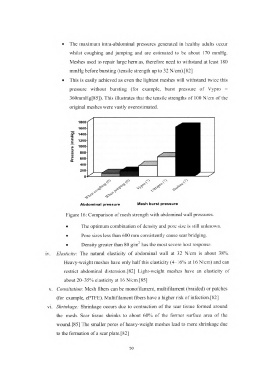
•  The  maximum  intra-abdominal  pressures  generated  in  healthy  adults  occur
                              whilst  coughing  and jumping  and  are  estimated  to  be  about  170  mmHg.

                              Meshes used to repair large hernias, therefore need to withstand at least  180
                              mmHg before bursting (tensile strength up to 32 N/cm).[82]
                           •  This is easily achieved as even the  lightest meshes will  withstand twice this

                              pressure  without  bursting  (for  example,  burst  pressure  of  Vypro  =
                              360mmHg[85]). This illustrates that the tensile strengths of 100 N/cm of the
                              original meshes were vastly overestimated.


                                  A b d o m in a l  p re s s u r e  M e s h   b u r s t  p re s s u r e
                             Figure  16: Comparison of mesh strength with abdominal wall pressures.

                             •     The optimum combination of density and pore size is still unknown.

                             •     Pore sizes less than 600 mm consistently cause scar bridging.
                             •     Density greater than 80 g/m2 has the most severe host response.

                    iv.  Elasticity:  The  natural  elasticity  of  abdominal  wall  at  32  N/cm  is  about  38%.
                            Heavy-weight meshes have only half this elasticity (4-16% at  16 N/cm) and can
                            restrict  abdominal  distension.[82]  Light-weight  meshes  have  an  elasticity  of
                            about 20-35% elasticity at  16 N/cm.[85]

                     v.  Constitution: Mesh fibers can be monofilament, multifilament (braided) or patches
                         (for example, ePTFE). Multifilament fibers have a higher risk of infection.[82]
                     vi.  Shrinkage:  Shrinkage  occurs  due  to  contraction  of the  scar tissue  formed  around

                         the  mesh.  Scar  tissue  shrinks  to  about  60%  of the  former  surface  area  of the
                         wound.[85] The smaller pores of heavy-weight meshes lead to more shrinkage due
                         to the formation of a scar plate. [82]


                                                       50

