


Page 112 - Demo
P. 112
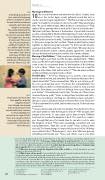
10:6 In speaking about divorce, Jesus evokes the beginning of the book of Genesis, where the man and the woman are created for each other and delight in one another: “The Lord God then built the rib that he had taken from the man into a woman. When he brought her to the man, the man said: ‘This one, at last, is bone of my bones / and esh of my esh; / This one shall be called ‘woman,’ / for out of man this one has been taken.’ That is why a man leaves his father and mother and clings to his wife, and the two of them become one body” (Genesis 2:22-24).
10:23 “How hard it is for those who have wealth to enter the kingdom of God!” Jesus’ disciples are stunned at his words, because in the ancient world it was common to see an abundance of possessions as a sign of God’s favor. Jesus reveals to them a new image of God, who has a special love not for the rich, but for the poor.
MARK
Marriage and Divorce.
1011He set out from there and went into the district of Judea [and] across the Jordan. Again crowds gathered around him and, as was his custom, he again taught them. 2* The Pharisees approached and asked, “Is it lawful for a husband to divorce his wife?” They were testing him.a 3He said to them in reply, “What did Moses command you?” 4They replied, “Moses permitted him to write a bill of divorce and dismiss her.”b 5But Jesus told them, “Because of the hardness of your hearts he wrote you this commandment. 6But from the beginning of creation, ‘God made them male and female.c 7For this reason a man shall leave his father and mother [and be joined to his wife],d 8and the two shall become one flesh.’ So they are no longer two but one flesh. 9Therefore what God has joined together, no human being must separate.” 10In the house the disciples again questioned him about this. 11e He said to them, “Whoever divorces his wife and marries another commits adultery against her; 12and if she
divorces her husband and marries another, she commits adultery.” Blessing of the Children. 13f And people were bringing children to him that he might touch them, but the disciples rebuked them.g 14When Jesus saw this he became indignant and said to them, “Let the children come to me; do not prevent them, for the kingdom of God belongs to such as these. 15Amen, I say to you, whoever does not accept the kingdom of God like a child* will not enter it.”h 16Then he embraced them and blessed them, placing his hands on them.
The Rich Man. 17i As he was setting out on a journey, a man ran up, knelt down before him, and asked him, “Good teacher, what must I do to inherit eternal life?” 18Jesus answered him, “Why do you call me good?* No one is good but God alone. 19You know the commandments: ‘You shall not kill; you shall not commit adultery; you shall not steal; you shall not bear false witness; you shall not defraud; honor your father and your mother.’”j 20He replied and said to him, “Teacher, all of these I have observed from my youth.” 21Jesus, looking at him, loved him and said to him, “You are lacking in one thing. Go, sell what you have, and give to [the] poor and you will have treasure in heaven; then come, follow me.” 22At that statement his face fell, and he went away sad, for he had many possessions.
23* Jesus looked around and said to his disciples, “How hard it is for those who have wealth to enter the kingdom of God!”k 24The disciples were amazed at his words. So Jesus again said to them in reply, “Children, how hard it is to enter the kingdom of God! 25It is easier for a camel to pass through [the] eye of [a] needle than for one who is rich to enter the kingdom of God.” 26They were exceedingly astonished and said among themselves, “Then who can be saved?” 27Jesus looked at them and said, “For human beings it is impossible, but not for God. All things are possible for God.” 28Peter began to say to him, “We have given up everything and followed you.” 29Jesus said, “Amen, I say to you, there
* [10:2–9] In the dialogue between Jesus and the Pharisees on the subject of divorce, Jesus declares that the law of Moses permitted divorce (Dt 24:1) only because of the hardness of your hearts (Mk 10:4–5). In citing Gn 1:27 and 2:24 Jesus proclaims permanence to be the divine intent from the beginning concerning human marriage (Mk 10:6–8). He rea rms this with the declaration that what God has joined together, no human being must separate (Mk 10:9). See further the notes on Mt 5:31–32; 19:3–9.
* [10:15] Whoever does not accept the kingdom of God like a child: i.e., in total dependence upon and obedience to the gospel; cf. Mt 18:3–4.
* [10:18] Why do you call me good?: Jesus repudiates the term “good” for himself and directs it to God, the source of all goodness who alone can grant the gift of eternal life; cf. Mt 19:16–17.
* [10:23–27] In the Old Testament wealth and material goods are considered a sign of God’s favor (Jb 1:10; Ps 128:1–2; Is 3:10). The words of Jesus in Mk 10:23–25 provoke astonishment among the disciples because of their apparent contradiction of the Old Testament concept (Mk 10:24, 26). Since wealth, power, and merit generate false security, Jesus rejects them utterly as a claim to enter the kingdom. Achievement of salvation is beyond human capability and depends solely on the goodness of God who o ers it as a gift (Mk 10:27).
100
a. [10:2–12] Mt 19:3–9.
b. [10:4] Dt 24:1–4.
c. [10:6] Gn 1:27.
d. [10:7–8] Gn 2:24; 1 Cor 6:16; Eph 5:31.
e. [10:11–12] Mt 5:32; Lk 16:18; 1 Cor 7:10–11. f. [10:13–16] Mt 19:13–15; Lk 18:15–17.
g. [10:13] Lk 9:47.
h. [10:15] Mt 18:3.
i. [10:17–31] Mt 19:16–30; Lk 18:18–30. j. [10:19] Ex 20:12–16; Dt 5:16–21.
k. [10:23] Prv 11:28.


