


Page 113 - Demo
P. 113
MARK
is no one who has given up house or brothers or sisters or mother or father or children or lands for my sake and for the sake of the gospel
who will not receive a hundred times more now in this present age: houses and brothers and sisters and mothers and children and lands, with persecutions, and eternal life in the age to come. 31But many that are first will be last, and [the] last will be first.”l
The Third Prediction of the Passion. 32m They were on the way, going up to Jerusalem, and Jesus went ahead of them. They were amazed, and those who followed were afraid. Taking the Twelve aside again, he began to tell them what was going to happen to him. 33“Behold, we are going up to Jerusalem, and the Son of Man will be handed over to the chief priests and the scribes, and they will condemn him to death and hand him over to the Gentiles 34who will mock him, spit upon him, scourge him, and put him to death, but after three days he will rise.”
Ambition of James and John. 35n Then James and John, the sons of Zebedee, came to him and said to him, “Teacher, we want you to do for us whatever we ask of you.” 36He replied, “What do you wish [me] to do for you?” 37They answered him, “Grant that in your glory we may sit one at your right and the other at your left.” 38* o Jesus said to them, “You do not know what you are asking. Can you drink the cup that I drink or be baptized with the baptism with which I am baptized?” 39They said to him, “We can.” Jesus said to them, “The cup that I drink, you will drink, and with the baptism with which I am baptized, you will be baptized; 40but to sit at my right or at my left is not mine to give but is for those for whom it has been prepared.” 41When the ten heard this, they became indignant at James and John. 42* Jesus summoned them and said to them,p “You know that those who are recognized as rulers over the Gentiles lord it over them, and their great ones make their authority over them felt. 43But it shall not be so among you. Rather, whoever wishes to be great among you will be your servant; 44whoever wishes to be first among you will be the slave of all. 45For the Son of Man did not come to be served but to serve and to give his life as a ransom for many.”
The Blind Bartimaeus.* 46They came to Jericho.q And as he was leaving Jericho with his disciples and a sizable crowd, Bartimaeus, a blind man, the son of Timaeus, sat by the roadside begging. 47On hearing that it was Jesus of Nazareth, he began to cry out and say, “Jesus, son of David, have pity on me.” 48And many rebuked him, telling him to be silent. But he kept calling out all the more, “Son of David, have pity on me.” 49Jesus stopped and said, “Call him.” So they called the blind man, saying to him, “Take courage; get up, he is calling you.” 50He threw aside his cloak, sprang up, and came to Jesus. 51Jesus said to him in reply, “What do you want me to do for you?” The blind man replied to him, “Master, I want to see.” 52Jesus told him, “Go your way; your faith has saved you.” Immediately he received his sight and followed him on the way.
30
10:32
For the third time, Jesus predicts his approaching passion and death, and again the prediction is followed by con ict among the disciples: James and John come to him asking for the best places in the kingdom, at Christ’s left and right. Jesus does not promise them places of honor; instead, he promises that they will drink from his cup and undergo the same baptism—in other words, they will share fully in his su ering.
10:46
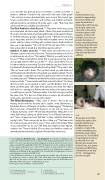
The Gospels do not often mention the names of the people healed by Jesus,
but Bartimaeus is an exception. In spite of the crowds surrounding Jesus, Bartimaeus keeps calling upon Jesus as “Son of David,” recognizing him as the one promised by God—the Messiah, who would come of David’s line. Jesus grants his prayer, and Bartimaeus “followed him on the way” (10:52)—the beggar has become a disciple.
101
* [10:38–40] Can you drink the cup. . .I am baptized?: the metaphor of drinking the cup is used in the Old Testament to refer to acceptance of the destiny assigned by God; see note on Psalm 11:6. In Jesus’ case, this involves divine judgment on sin that Jesus the innocent one is to expiate on behalf of the guilty (Mk 14:24; Is 53:5). His baptism is to be his cruci xion and death for the salvation of the human race; cf. Lk 12:50. The request of James and John for a share in the glory (Mk 10:35–37) must of necessity involve a share in Jesus’ su erings, the endurance of tribulation and su ering for the gospel (Mk 10:39). The authority of assigning places of honor in the kingdom is reserved to God (Mk 10:40).
* [10:42–45] Whatever authority is to be exercised by the disciples must, like that of Jesus, be rendered as service to others (Mk 10:45) rather than for personal aggrandizement (Mk 10:42 44). The service of Jesus is his passion and death for the sins of the human race (Mk 10:45); cf. Mk 14:24; Is 53:11–12; Mt 26:28; Lk 22:19–20.
* [10:46–52] See notes on Mt 9:27–31 and 20:29–34.
l. [10:31] Mt 19:30; Lk 13:30.
m. [10:32–34] 8:31; Mt 20:17–19; Lk 18:31–33. n. [10:35–45] Mt 20:20–28.
o. [10:38] Lk 12:50.
p. [10:42–45] Lk 22:25–27.
q. [10:46–52] Mt 20:29–34; Lk 18:35–43.


