


Page 121 - Demo
P. 121
MARK
Peter’s Denial Foretold.* 27Then Jesus said to them, “All of you will have your faith shaken, for it is written:
‘I will strike the shepherd,
and the sheep will be dispersed.’h
28But after I have been raised up, I shall go before you to Galilee.” 29Peter said to him, “Even though all should have their faith shaken, mine will not be.” 30Then Jesus said to him, “Amen, I say to you, this very night before the cock crows twice you will deny me three times.” 31But he vehemently replied, “Even though I should have to die with you, I will not deny you.” And they all spoke similarly.
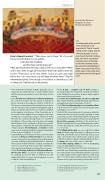
Icon of the Mystical Banquet by Joan Brand-Landkamer
14:6
An unnamed woman anoints Jesus’ head with costly imported oil. The oil is worth nearly a year’s wages, and yet the woman pours it out on
Jesus’ head: she holds nothing back. Her action is prophetic, anointing Jesus as the kings
of old were anointed, but at
the same time anticipating his death. Jesus praises her action, which may not be useful, but is nevertheless profoundly “good” (14:7).
* [14:1–16:8] In the movement of Mark’s gospel the cross is depicted as Jesus’ way to glory in accordance with the divine will. Thus the passion narrative is seen as the climax of Jesus’ ministry.
* [14:1] The Passover and the Feast of Unleavened Bread: the connection between the two festivals is reflected in Ex 12:3–20; 34:18; Lv 23:4–8; Nm 9:2–14; 28:16–17; Dt 16:1–8. The Passover commemorated the redemption from slavery and the departure of the Israelites from Egypt by night. It began at sundown after the Passover lamb was sacrificed in the temple in the afternoon of the fourteenth day of the month of Nisan. With the Passover supper on the same evening was associated the eating of unleavened bread. The latter was continued through Nisan 21, a reminder of the affliction of the Israelites and of the haste surrounding their departure. Praise and thanks to God for his goodness in the past were combined at this dual festival with the hope of future salvation. The chief priests. . .to death: the intent to put Jesus to death was plotted for a long time but delayed for fear of the crowd (Mk 3:6; 11:18; 12:12).
* [14:3] At Bethany on the Mount of Olives, a few miles from Jerusalem, in the house of Simon the leper, Jesus defends a woman’s loving action of anointing his head with perfumed oil in view of his impending death and burial as a criminal, in which case his body would not be anointed. See further the note on Jn 12:7. He assures the woman of the remembrance of her deed in the worldwide preaching of the good news.
* [14:12] The first day of the Feast of Unleavened Bread. the Passover lamb: a less precise designation of the day for sacrificing the Passover lamb as evidenced by some rabbinical literature. For a more exact designation, see note on Mk 14:1. It was actually Nisan 14.
a. [14:1–2] Mt 26:2–5; Lk 22:1–2; Jn 11:45–53. b. [14:3–9] Mt 26:6–13; Jn 12:1–8.
c. [14:10–11] Mt 26:14–16; Lk 22:3–6.
d. [14:12–16] Mt 26:17–19; Lk 22:7–13.
* [14:13] A man. . .carrying a jar of water: perhaps a prearranged signal, for only women ordinarily carried water in jars. The Greek word used here, however, implies simply a person and not necessarily a male.
* [14:18] One of you will betray me, one who is eating with me: contrasts the intimacy of table fellowship at the Passover meal with the treachery of the traitor; cf. Ps 41:10.
* [14:21] The Son of Man indeed goes, as it is written of him: a reference to Ps 41:10 cited by Jesus concerning Judas at the Last Supper; cf. Jn 13:18–19.
* [14:22–24] The actions and words of Jesus express within the framework of the Passover meal and the transition to a new covenant the sacrifice of himself through the offering of his body and blood in anticipation of his passion and death. His blood of the covenant both alludes to the ancient rite of Ex 24:4–8 and indicates the new community that the sacrifice of Jesus will bring into being (Mt 26:26–28; Lk 22:19–20; 1 Cor 11:23–25).
* [14:24] Which will be shed: see note on Mt 26:27–28. For many: the Greek preposition hyper is a different one from that at Mt 26:28 but the same as that found at Lk 22:19, 20 and 1 Cor 11:24. The sense of both words is vicarious, and it is difficult in Hellenistic Greek to distinguish between them. For many in the sense of “all,” see note on Mt 20:28.
* [14:26] After singing a hymn: Ps 114–118, thanksgiving songs concluding the Passover meal.
* [14:27–31] Jesus predicted that the Twelve would waver in their faith, even abandon him, despite their protestations to the contrary. Yet he reassured them that after his resurrection he would regather them in Galilee (Mk 16:7; cf. Mt 26:32; 28:7, 10, 16; Jn 21), where he first summoned them to be his followers as he began to preach the good news (Mk 1:14–20).
e. [14:17–21] Mt 26:20–24; Lk 22:21–23; Jn 13:21–26.
f. [14:22–25] Mt 26:26–30; Lk 22:19–20; 1 Cor 11:23–25. g. [14:26–31] Mt 26:30–35; Lk 22:34, 39; Jn 13:36–38.
h. [14:27] Zec 13:7; Jn 16:32.
109


