


Page 123 - Demo
P. 123
MARK
63At that the high priest tore his garments and said, “What further need have we of witnesses? 64You have heard the blasphemy. What do you think?” They all condemned him as deserving to die. 65Some began to spit on him. They blindfolded him and struck him and said to him, “Prophesy!” And the guards greeted him with blows.p
Peter’s Denial of Jesus. 66q While Peter was below in the courtyard, one of the high priest’s maids came along. 67Seeing Peter warming himself, she looked intently at him and said, “You too were with the Nazarene, Jesus.” 68* But he denied it saying, “I neither know nor understand what you are talking about.” So he went out into the outer court. [Then the cock crowed.] 69The maid saw him and began again to say to the bystanders, “This man is one of them.” 70Once again he denied it. A little later the bystanders said to Peter once more, “Surely you are one of them;foryoutooareaGalilean.”71Hebegantocurseandtoswear,“Ido not know this man about whom you are talking.” 72And immediately a cock crowed a second time. Then Peter remembered the word that Jesus had said to him, “Before the cock crows twice you will deny me three times.” He broke down and wept.r
14:53
Jesus is brought before the Sanhedrin, a religious court. In keeping with the Mosaic law, Jesus will not be condemned on the testimony of a single witness, and so e orts are made to nd two people willing to bring testimony against him. In the midst of this mockery of justice, Jesus speaks simply and directly. His words, “I am,” a rm that he is “the Messiah, the son of the Blessed One” (14:61).
“Tears brought Peter by penitence to Christ..
For behold Peter, who had also received the Body and Blood of the Lord, is received by penitence; for the failings of saints are written, that if we fall by want of caution, we also may be able to run back through their example, and hope to be relieved by penitence” (Theophylact).2
2 e Golden Chain.
* [14:32–34] The disciples who had witnessed the raising to life of the daughter of Jairus (Mk 5:37) and the transfiguration of their Master (Mk 9:2) were now invited to witness his degradation and agony and to watch and pray with him.
* [14:36] Abba, Father: an Aramaic term, here also translated by Mark, Jesus’ special way of addressing God with filial intimacy. The word ’abbā’ seems not to have been used in earlier or contemporaneous Jewish sources to address
God without some qualifier. Cf. Rom 8:15; Gal 4:6 for
other occurrences of the Aramaic word in the Greek New Testament. Not what I will but what you will: note the complete obedient surrender of the human will of Jesus to the divine will of the Father; cf. Jn 4:34; 8:29; Rom 5:19; Phil 2:8; Heb 5:8.
* [14:38] The spirit is willing but the flesh is weak: the spirit is drawn to what is good yet found in conflict with the flesh, inclined to sin; cf. Ps 51:7, 12. Everyone is faced with this struggle, the full force of which Jesus accepted on our behalf and, through his bitter passion and death, achieved the victory.
* [14:53] They led Jesus away. . .came together: Mark presents a formal assembly of the whole Sanhedrin (chief priests, elders, and scribes) at night, leading to the condemnation of Jesus (Mk 14:64), in contrast to Lk 22:66, 71 where Jesus is condemned in a daytime meeting of the council; see also Jn 18:13, 19–24.
* [14:57–58] See notes on Mt 26:60–61 and Jn 2:19.
* [14:61–62] The Blessed One: a surrogate for the divine name, which Jews did not pronounce. I am: indicates Jesus’ acknowledgment that he is the Messiah and Son of God; cf. Mk 1:1. Contrast Mt 26:64 and Lk 22:67–70, in which Jesus leaves his interrogators to answer their own question. You will see the Son of Man. . .with the clouds of heaven: an allusion to Dn 7:13 and Ps 110:1 portending the enthronement of Jesus as judge in the transcendent glory of God’s kingdom. The Power:
another surrogate for the name of God.
* [14:68] [Then the cock crowed]: found in most
manuscripts, perhaps in view of Mk 14:30, 72 but omitted in others.
i. [14:32–42] Mt 26:36–46; Lk 22:40–46.
j. [14:32] Jn 18:1.
k. [14:38] Rom 7:5.
l. [14:43–50] Mt 26:47–56; Lk 22:47–53; Jn 18:3–11.
m. [14:53–65] Mt 26:57–68; Lk 22:54–55, 63–65, 67–71; Jn 18:12–13. n. [14:58] 15:29; 2 Cor 5:1.
o. [14:62] 13:26; Ps 110:1; Dn 7:13; Mt 24:30.
p. [14:65] Lk 22:63–65.
q. [14:66–72] Mt 26:69–75; Lk 22:56–62; Jn 18:16–18, 25–27. r. [14:72] Jn 13:38.
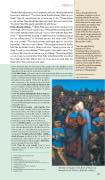
The Kiss of Judas in the Book of Hours of Marguerite de Coetivy ( fteenth century)
111


