


Page 125 - Demo
P. 125
MARK
The Crucifixion. 22f They brought him to the place of Golgotha (which is translated Place of the Skull). 23They gave him wine drugged with
24* g
myrrh, but he did not take it. Then they crucified him and divided
his garments by casting lots for them to see what each should take. 25It was nine o’clock in the morning* when they crucified him. 26* The inscription of the charge against him read, “The King of the Jews.” 27With him they crucified two revolutionaries, one on his right and one on his left.h [28]* 29* Those passing by reviled him, shaking their heads and saying,i “Aha! You who would destroy the temple and rebuild it in three days, 30save yourself by coming down from the cross.” 31Likewise the chief priests, with the scribes, mocked him among themselves and said, “He saved others; he cannot save himself. 32Let the Messiah, the King of Israel, come down now from the cross that we may see and believe.”Those who were crucified with him also kept abusing him.j
Mark’s account of Jesus’ last hours on the cross is full of echoes of the Old Testament. Jesus cries out from the cross in the words of Psalm 22: “My God, my God, why have you abandoned me?
/ Why so far from my call
for help, / from my cries of anguish? / My God, I call by day, but you do not answer;
/ by night, but I have no relief” (Psalm 22:2-3). Some passers-by misunderstand the word “Eloi” and think Jesus is calling on the prophet Elijah for aid. At the moment of Jesus’ death, the veil in
the Temple is torn down the middle: now all people, Jews and Gentiles alike, will have access to the Father through Christ.
113
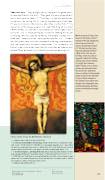
Christ on the Cross, by Barthelemy van Eyck
* [15:24] See notes on Mt 27:35 and Jn 19:23–25a.
* [15:25] It was nine o’clock in the morning: literally, “the third hour,” thus between 9 a.m. and 12 noon. Cf. Mk 15:33, 34, 42 for Mark’s chronological sequence, which may reflect liturgical or catechetical considerations rather than the precise historical sequence of events; contrast the different chronologies in the other gospels, especially Jn 19:14.
* [15:26] The inscription. . .the King of the Jews: the political reason for the death penalty falsely charged by the enemies of Jesus. See further the notes on Mt 27:37 and Jn 19:19. * [15:28] This verse, “And the scripture was fulfilled that says, ‘And he was counted among the wicked,’” is omitted in the earliest and best manuscripts. It contains a citation from Is 53:12 and was probably introduced from Lk 22:37.
* [15:29] See note on Mt 27:39–40.
f. [15:22–38] Mt 27:33–51; Lk 23:32–46; Jn 19:17–30. g. [15:24] Ps 22:18.
h. [15:27] Lk 23:33.
i. [15:29] Jn 2:19. j. [15:32] Lk 23:39.


