


Page 138 - Demo
P. 138
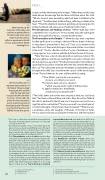
2:19 Mary treasures up the memories of these days and continues to ponder them in her heart. Luke invites every reader to do the same: to re ect on each event in the life of Jesus, and ponder its deeper meaning for us.
2:25 Simeon and Anna are not important representatives of the Temple. They are simply holy people who are lled with the Holy Spirit and recognize the Messiah when he comes. Simeon takes the child in his arms and praises God in a canticle, a poem of thanksgiving and of farewell: now that God’s promises are ful lled, he can die in peace.
LUKE
Joseph, and the infant lying in the manger. 17When they saw this, they made known the message that had been told them about this child. 18All who heard it were amazed by what had been told them by the shepherds. 19And Mary kept all these things, reflecting on them in her heart. 20Then the shepherds returned, glorifying and praising God for all they had heard and seen, just as it had been told to them.
The Circumcision and Naming of Jesus. 21When eight days were completed for his circumcision,* he was named Jesus, the name given him by the angel before he was conceived in the womb.g
The Presentation in the Temple. 22* When the days were completed for their purification* according to the law of Moses, they took him up to Jerusalem to present him to the Lord,h 23just as it is written in the law of the Lord, “Every male that opens the womb shall be consecrated to the Lord,”i 24and to offer the sacrifice of “a pair of turtledoves or two young pigeons,” in accordance with the dictate in the law of the Lord.
25Now there was a man in Jerusalem whose name was Simeon. This man was righteous and devout, awaiting the consolation of Israel,* and the holy Spirit was upon him. 26It had been revealed to him by the holy Spirit that he should not see death before he had seen the Messiah of the Lord. 27He came in the Spirit into the temple; and when the parents brought in the child Jesus to perform the custom of the law in regard to him, 28he took him into his arms and blessed God, saying:
29“Now, Master, you may let your servant go in peace, according to your word,
30for my eyes have seen your salvation,j
31which you prepared in sight of all the peoples,
32a light for revelation to the Gentiles, and glory for your people Israel.”k
33The child’s father and mother were amazed at what was said about him; 34and Simeon blessed them and said to Mary his mother, “Behold, this child is destined for the fall and rise of many in Israel, and to be a sign that will be contradictedl 35(and you yourself a sword will pierce)* so that the thoughts of many hearts may be revealed.” 36There was also a prophetess, Anna, the daughter of Phanuel, of the tribe of Asher. She was advanced in years, having lived seven years with her husband
* [2:21] Just as John before him had been incorporated into the people of Israel through his circumcision, so too this child (see note on Lk 1:57–66).
* [2:22–40] The presentation of Jesus in the temple depicts the parents of Jesus as devout Jews, faithful observers of the law of the Lord (Lk 2:23–24, 39), i.e., the law of Moses. In this respect, they are described in a fashion similar to the parents of John (Lk 1:6) and Simeon (Lk 2:25) and Anna (Lk 2:36–37).
* [2:22] Their puri cation: syntactically, their must refer to Mary and Joseph, even though the Mosaic law never mentions the puri cation of the husband. Recognizing the problem, some Western scribes have altered the text to read “his puri cation,” understanding the presentation of Jesus in the temple as a form of puri cation; the Vulgate version has a Latin form that could be either “his” or “her.” According to the Mosaic law (Lv 12:2–8), the woman who gives birth to a boy is unable for forty days to touch anything sacred or to enter the temple area by reason of her legal impurity. At the end of this period she is required to o er a year-old lamb as a burnt o ering and a turtledove or young pigeon as an expiation of sin. The woman who could not a ord a lamb o ered instead two turtledoves or two young pigeons, as Mary does here. They took him up to Jerusalem
to present him to the Lord: as the rstborn son (Lk 2:7) Jesus was consecrated to the Lord as the law required (Ex 13:2, 12), but there was no requirement that this be done at the temple. The concept of a presentation at the temple is probably derived from 1 Sm 1:24–28, where Hannah o ers the child Samuel for sanctuary services. The law further stipulated (Nm 3:47–48) that the rstborn son should be redeemed by the parents through their payment of ve shekels to a member of a priestly family. About this legal requirement Luke is silent.
* [2:25] Awaiting the consolation of Israel: Simeon here and later Anna who speak about the child to all who were awaiting the redemption of Jerusalem represent the hopes and expectations of faithful and devout Jews who at this time were looking forward to the restoration of God’s rule in Israel. The birth of Jesus brings these hopes to ful llment.
* [2:35] (And you yourself a sword will pierce): Mary herself will not be untouched by the various reactions to the role of Jesus (Lk 2:34). Her blessedness as mother of the Lord will be challenged by her son who describes true blessedness as “hearing the word of God and observing it” (Lk 11:27–28 and Lk 8:20–21).
j. [2:30–31] 3:6; Is 40:5 LXX; 52:10.
k. [2:32] Is 42:6; 46:13; 49:6; Acts 13:47; 26:23.
l. [2:34] 12:51; Is 8:14; Jn 9:39; Rom 9:33; 1 Cor 1:23; 1 Pt 2:7–8.
126
g. [2:21] 1:31; Gn 17:12; Mt 1:21. h. [2:22–24] Lv 12:2–8.
i. [2:23] Ex 13:2, 12.


