


Page 170 - Demo
P. 170
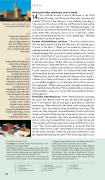
Fortress said to be David’s, but dating from the Middle Ages
14:10 “Give me the lowest place: or if for me / That lowest place too high, make one more low / Where I may sit and see / My God and love Thee so” (Christina Rossetti, 1830-1894).
14:16 In the parable of the banquet, each of the invited guests o ers a reason for not coming: they have purchased land or livestock, or they are recently married. Their excuses highlight the things that can absorb our energies and take us away from God: the desire to acquire property or wealth, possessive relationships with others. The end of the passage makes this clear: “Everyone of you who does not renounce all his possessions cannot be my disciple” (14:33). To be a disciple of Jesus, and yet allow our attention and energy to be divided between God and other things, is to be salt without savor— something utterly useless.
LUKE
Healing of the Man with Dropsy on the Sabbath.*
141a On a sabbath he went to dine at the home of one of the
leading Pharisees, and the people there were observing him carefully.b 2In front of him there was a man suffering from dropsy.* 3Jesus spoke to the scholars of the law and Pharisees in reply, asking, “Is it lawful to cure on the sabbath or not?”c 4But they kept silent; so he took the man and, after he had healed him, dismissed him. 5Then he said to them, “Who among you, if your son or ox* falls into a cistern, would not immediately pull him out on the sabbath day?”d 6But they were unable to answer his question.e
Conduct of Invited Guests and Hosts.* 7f He told a parable to those who had been invited, noticing how they were choosing the places of honor at the table. 8g “When you are invited by someone to a wedding banquet, do not recline at table in the place of honor. A more distinguished guest than you may have been invited by him, 9and the host who invited both of you may approach you and say, ‘Give your place to this man,’ and then you would proceed with embarrassment to take the lowest place. 10Rather, when you are invited, go and take the lowest place so that when the host comes to you he may say, ‘My friend, move up to a higher position.’ Then you will enjoy the esteem of your companions at the table. 11For everyone who exalts himself will be humbled, but the one who humbles himself will be exalted.”h 12Then he said to the host who invited him, “When you hold a lunch or a dinner, do not invite your friends or your brothers or your relatives or your wealthy neighbors, in case they may invite you back and you have repayment.i 13Rather, when you hold a banquet, invite the poor, the crippled, the lame, the blind; 14blessed indeed will you be because of their inability to repay you. For you will be repaid at the resurrection of the righteous.”j
The Parable of the Great Feast.* 15One of his fellow guests on hearing this said to him, “Blessed is the one who will dine in the kingdom of God.” 16k He replied to him, “A man gave a great dinner to which he invited many. 17When the time for the dinner came, he dispatched his servant to say to those invited, ‘Come, everything is now ready.’ 18But one by one, they all began to excuse themselves. The first said to him, ‘I have purchased a field and must go to examine it; I ask you, consider me excused.’ 19And another said, ‘I have purchased five yoke of oxen and am on my way to evaluate them; I ask you, consider me excused.’ 20And another said, ‘I have just married a woman, and therefore I cannot come.’ 21The servant went and reported this to his master. Then the master of the house in a rage commanded his servant, ‘Go out quickly into the streets and alleys of the town and bring in here the poor and the crippled, the blind and the lame.’ 22The servant reported, ‘Sir, your
* [14:1–6] See note on Lk 13:10–17.
* [14:2] Dropsy: an abnormal swelling of the body because of the
retention and accumulation of uid.
* [14:5] Your son or ox: this is the reading of many of the oldest
and most important New Testament manuscripts. Because of the strange collocation of son and ox, some copyists have altered it to “your ass or ox,” on the model of the saying in Lk 13:15.
* [14:7–14] The banquet scene found only in Luke provides the opportunity for these teachings of Jesus on humility and presents
a setting to display Luke’s interest in Jesus’ attitude toward the rich
and the poor (see notes on Lk 4:18; 6:20–26; 12:13–34).
* [14:15–24] The parable of the great dinner is a further illustration of the rejection by Israel, God’s chosen people, of Jesus’ invitation to share in the banquet in the kingdom and the extension of the invitation to other Jews whose identi cation as the poor, crippled, blind, and lame (Lk 14:21) classi es them among those who recognize their need for salvation, and to Gentiles (Lk 14:23).
A similar parable is found in Mt 22:1–10.
a. [14:1–6] 6:6–11; 13:10–17.
b. [14:1] 11:37.
c. [14:3] 6:9; Mk 3:4.
d. [14:5] 13:15; Dt 22:4; Mt 12:11.
e. [14:6] Mt 22:46.
f. [14:7] 11:43; Mt 23:6; Mk 12:38–39. g. [14:8–10] Prv 25:6–7.
h. [14:11] 18:14.
i. [14:12] 6:32–35.
j. [14:14] Jn 5:29.
k. [14:16–24] Mt 22:2–10.
158


