


Page 240 - Demo
P. 240
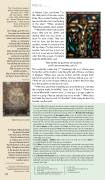
The Cruci xion, stained- glass window by Georges Rouault (1871-1958). The inscription “INRI” is the Latin abbreviation for “Iesous Nazarenus Rex Iudaoerum,” which means “Jesus of Nazareth, King of the Jews”.
As he hangs upon the cross, Jesus gives his mother and the beloved disciple into each other’s care. He establishes a family—a community. “Lord you left your Mother in our midst that she might accompany us. May she take care of us and protect us on our journey, in our hearts, in our faith. May she make us disciples like herself, missionaries like herself. May she teach us to go out onto the streets. May she teach us to step outside ourselves.... May she, by her meekness, by her peace, show us the way.2”
Pope Francis
© Bart Kwieciszewski
The image of Mary holding the body of the dead Christ, known as the Pietà (from the Italian for pity or compassion), is one of the most familiar artistic representations of Jesus and Mary. Though not described in the Gospels, this episode has been handed down by tradition and has inspired the religious imagination of countless artists.
2 Pope Francis, http://www.vatican.va/ holy_father/francesco/speeches/2013/july/ documents/papa-francesco_20130725_ gmg-argentini-rio_en.html.
228
JOHN
in Hebrew, Latin, and Greek. 21So the chief priests of the Jews said to Pilate, “Do not write ‘The King of the Jews,’ but that he said, ‘I am the King of the Jews.’”j 22Pilate answered, “What I have written, I have written.”
23* When the soldiers had cruci ed Jesus,k they took his clothes and divided them into four shares, a share for each soldier.l They also took his tunic, but the tunic was seamless, woven in one piece from the top down. 24So they said to one another, “Let’s not tear it, but cast lots for it to see whose it will be,” in order that the passage of scripture might be ful lled [that says]:
“They divided my garments among them, and for my vesture they cast lots.”
This is what the soldiers did. 25* m Standing by the cross of Jesus were his mother and his mother’s sister, Mary the wife of Clopas, and Mary of Magdala. 26When Jesus saw his mother* and the disciple there whom he loved, he said to his mother, “Woman, behold, your son.”n 27Then he said to the disciple, “Behold, your mother.” And from that hour the disciple took her into his home.
28oAfter this, aware that everything was now nished, in order that the scripture might be ful lled,* Jesus said, “I thirst.”p 29There was a vessel lled with common wine.* So they put a sponge soaked in wine on a sprig of hyssop and put it up to his mouth. 30* When Jesus had taken the wine, he said, “It is nished.”q And bowing his head, he handed over the spirit.
* [19:23–25a] While all four gospels describe the soldiers casting lots to divide Jesus’ garments (see note on Mt 27:35), only John quotes the underlying passage from Ps 22:19, and only John sees each line of the poetic parallelism literally carried out in two separate actions (Jn 19:23–24).
* [19:25] It is not clear whether four women are meant, or three (i.e., Mary the wife of Cl[e]opas [cf. Lk 24:18] is in apposition with his mother’s sister) or two (his mother and his mother’s sister, i.e., Mary of Cl[e]opas and Mary of Magdala). Only John mentions the mother of Jesus here. The synoptics have a group of women looking on from a distance at the cross (Mk 15:40).
* [19:26–27] This scene has been interpreted literally, of Jesus’ concern for his mother; and symbolically, e.g., in the light of the Cana story in Jn 2 (the presence of the mother of Jesus, the address woman, and the mention of the hour) and of the upper room in Jn 13 (the presence of the beloved disciple; the hour). Now that the hour has come (Jn 19:28), Mary (a symbol of the church?) is given a role as the mother of Christians (personi ed by the beloved disciple); or, as a representative of those seeking salvation, she is supported by the disciple who interprets Jesus’ revelation; or Jewish and Gentile Christianity (or Israel and the Christian community) are reconciled.
* [19:28] The scripture. . .ful lled: either in the scene of Jn 19:25–27, or in the I thirst of Jn 19:28. If the latter, Ps 22:16; 69:22 deserve consideration.
* [19:29] Wine: John does not mention the drugged wine, a narcotic that Jesus refused as the cruci xion began (Mk 15:23), but only this nal gesture of kindness at the end (Mk 15:36). Hyssop, a small plant, is scarcely suitable for carrying a sponge (Mark mentions a reed) and may be a symbolic reference to the hyssop used to daub the blood of the paschal lamb on the doorpost of the Hebrews (Ex 12:22).
* [19:30] Handed over the spirit: there is a double nuance of dying (giving up the last breath or spirit) and that of passing on the holy Spirit; see Jn 7:39, which connects the giving of the Spirit with Jesus’ glorious return to the Father, and Jn 20:22, where the author portrays the conferral of the Spirit.
j. [19:21] 18:33; Lk 19:14.
k. [19:23–27] Mt 27:38–44; Mk 15:27–32;
Lk 23:36–43.
l. [19:23–24] Ps 22:19; Mt 27:35; Mk 15:24; Lk 23:34.
m. [19:25] Mt 27:55; Mk 15:40–41; Lk 8:2; 23:49.
n. [19:26] 13:23.
o. [19:28–30] Mt 27:45–56; Mk 15:33–41;
Lk 23:44–49.
p. [19:28] Ps 22:16; 69:22.


