


Page 267 - Demo
P. 267
THE ACTS OF THE APOSTLES -
35Then Philip opened his mouth and, beginning with this scripture passage, he proclaimed Jesus to him. 36k As they traveled along the road they came to some water, and the eunuch said, “Look, there is water. What is to prevent my being baptized?” [37]*
38Then he ordered the chariot to stop, and Philip and the eunuch both went down into the water, and he baptized him. 39When they came out of the water, the Spirit of the Lord snatched Philip away, and the eunuch saw him no more, but continued on his
way rejoicing.l 40Philip came to Azotus, and went about proclaiming the good news to all the towns until he reached Caesarea.m
9Saul’s Conversion.
1* Now Saul, still breathing murderous threats against the disciples
ab2
of the Lord, went to the high priest and asked him for letters
to the synagogues in Damascus, that, if he should nd any men or women who belonged to the Way,* he might bring them back to Jerusalem in chains. 3On his journey, as he was nearing Damascus, a light from the sky suddenly ashed around him.c 4He fell to the ground and heard a voice saying to him, “Saul, Saul, why are you persecuting me?”d 5He said, “Who are you, sir?” The reply came, “I am Jesus, whom you are persecuting.e 6Now get up and go into the city and you will be told what you must do.”f 7The men who were traveling with him stood speechless, for they heard the voice but could see no one.g 8Saul got up from the ground, but when he opened his eyes he could see nothing;* so they led him by the hand and brought him to Damascus.h 9For three days he was unable to see, and he neither ate nor drank.
Saul’s Baptism. 10i There was a disciple in Damascus named Ananias, and the Lord said to him in a vision, “Ananias.” He answered, “Here I am, Lord.” 11The Lord said to him, “Get up and go to the street called Straight and ask at the house of Judas for a man from Tarsus named Saul. He is there praying,j 12and [in a vision] he has seen a man named Ananias come in and lay [his] hands on him, that he may regain his sight.” 13But Ananias replied, “Lord, I have heard from many sources about this man, what evil things he has done to your holy ones* in Jerusalem.k 14And here he has authority from the
9:1
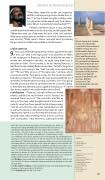
We met Saul in Acts 7, where he was one of those who consented to the execution of Stephen (see also Acts 8:1). On the road to Damascus, Saul encounters the risen Christ, and the persecutor becomes an ardent apostle. This encounter has frequently been represented in art, not only because of the drama of the scene, but because of the importance of this moment. Saul becomes Paul, the apostle to the Gentiles, the non-Jews. With the conversion of Saul, Christianity enters a decisive new moment.
CHAPTER 8
k. [8:36] 10:47.
l. [8:39] 1 Kgs 18:12. m.[8:40] 21:8.
CHAPTER 9
a. [9:1] 8:3; 9:13; 22:4; 1 Cor 15:9; Gal 1:13–14.
b.[9:1–2] 9:14; 26:10.
c. [9:3] 1 Cor 9:1; 15:8; Gal 1:16. d.[9:4] 22:6; 26:14.
e. [9:5] 22:8; 26:15; Mt 25:40.
f. [9:6] 22:10; 26:16.
g.[9:7] 22:9; 26:13–14.
h.[9:8] 22:11.
i. [9:10–19] 22:12–16.
j. [9:11] 21:39.
255
* [8:37] The oldest and best manuscripts of Acts omit this verse, which is a Western text reading: “And Philip said, ‘If you believe with all your heart, you may.’ And he said in reply, ‘I believe that Jesus Christ is the Son of God.’”
* [9:1–19] This is the rst of three accounts of Paul’s conversion (with Acts
22:3–16 and Acts 26:2–18) with some di erences of detail owing to Luke’s
use of di erent sources. Paul’s experience was not visionary but was precipitated by the appearance of Jesus, as he insists in 1 Cor 15:8. The words of Jesus, “Saul, Saul, why are you persecuting me?” related by Luke with no variation in all three accounts, exerted a profound and lasting in uence on the thought of Paul. Under the in uence of this experience he gradually developed his understanding of justi cation by faith (see the letters to the Galatians and Romans) and of the identi cation of the Christian community with Jesus Christ (see 1 Cor 12:27). That Luke would narrate this conversion three times is testimony to the importance he attaches to it. This rst account occurs when the word is rst spread to the Gentiles. At this point, the conversion of the hero of the Gentile mission is recounted. The emphasis in the account is on Paul as a divinely chosen instrument (Acts 9:15).
* [9:2] The Way: a name used by the early Christian community for itself (Acts 18:26; 19:9, 23; 22:4; 24:14, 22). The Essene community at Qumran used the same designation to describe its mode of life.
* [9:8] He could see nothing: a temporary blindness (Acts 9:18) symbolizing the religious blindness of Saul as persecutor (cf. Acts 26:18).
* [9:13] Your holy ones: literally, “your saints.”


