


Page 281 - Demo
P. 281
THE ACTS OF THE APOSTLES -
V. THE MISSION
OF PAUL TO THE ENDS OF THE EARTH
Paul and Barnabas Separate. 36* After some time, Paul said to Barnabas, “Come, let us make a return visit to see how the brothers are getting on in all the cities where we proclaimed the word of the Lord.” 37Barnabas wanted to take with them also John, who was called Mark, 38but Paul insisted that they should not take with them someone who had deserted them at Pamphylia and who had not continued with them in their work.m 39So sharp was their disagreement that they separated. Barnabas took Mark and sailed to Cyprus. 40But Paul chose Silas and departed after being commended by the brothers to the grace of the Lord. 41He traveled through Syria and Cilicia bringing strength to the churches.
Paul in Lycaonia: Timothy.
161He reached [also] Derbe and Lystra where there was a disciple named Timothy, the son of a Jewish woman who was a believer, but his father was a Greek.a 2The brothers in Lystra and Iconium spoke highly of him,b 3and Paul wanted him to come along with him. On account of the Jews of that region, Paul had him circumcised,* for they all knew that his father was a Greek. 4As they traveled from city to city, they handed on to the people for observance the decisions reached by the apostles and presbyters in Jerusalem. 5Day after day the churches
grew stronger in faith and increased in number.
Through Asia Minor. 6They traveled through the Phrygian and Galatian territory because they had been prevented by the holy Spirit from preaching the message in the province of Asia. 7When they came to Mysia, they tried to go on into Bithynia, but the Spirit of Jesus* did not allow them, 8so they
crossed through Mysia and came down
to Troas. 9During [the] night Paul had a
vision. A Macedonian stood before him
and implored him with these words,
“Come over to Macedonia and help
us.” 10When he had seen the vision, we*
sought passage to Macedonia at once,
concluding that God had called us to
proclaim the good news to them.
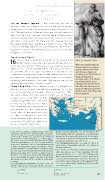
Paul, by Jacques Callot
When Paul and Barnabas set forth on their rst missionary journey, they had John Mark with them as a helper and companion, but he left them at Perga and returned to Jerusalem (Acts 13:13). We are not told why he left, but it is clear that Paul felt deserted by him. When Barnabas wants to bring John Mark along on their return journey, Paul refuses, and the two separate.
Thessalonica Philippi
ASIA MINOR
Antioch Iconium in PisidiaLystra
Berea
Troas
Athens Corinth
Ephesus
Derbe
Tarsus Antioch
Damas Caesarea
Jerusalem
* [15:36–18:22] This continuous narrative recounts Paul’s second missionary journey. On the internal evidence of the Lucan account, it lasted about three years. Paul rst visited the communities he had established on his rst journey (Acts 16:1–5), then pushed on into Macedonia, where he established communities at Philippi, Thessalonica, and Beroea (Acts 16:7–17:5). To escape the hostility of the Jews of Thessalonica, he left for Greece and while resident in Athens attempted, without success, to establish an e ective Christian community there. From Athens he proceeded to Corinth and, after a stay of a year and a half, returned to Antioch by way of Ephesus and Jerusalem (Acts 17:16–18:22). Luke does not concern himself with the structure or statistics of the communities but aims to show the general progress of the gospel in the Gentile world as well as its continued failure to take root in the Jewish community.
* [16:3] Paul had him circumcised: he did this in order that Timothy might be able to associate with the Jews and so
CHAPTER 15
m. [15:38] 13:13.
perform a ministry among them. Paul did not object to the Jewish Christians’ adherence to the law. But he insisted that the law could not be imposed on the Gentiles. Paul himself lived in accordance with the law, or as exempt from the law, according to particular circumstances (see 1 Cor 9:19–23).
* [16:7] The Spirit of Jesus: this is an unusual formulation in Luke’s writings. The parallelism with Acts 16:6 indicates its meaning, the holy Spirit.
* [16:10–17] This is the rst of the so-called “we-sections” in Acts, where Luke writes as one of Paul’s companions. The other passages are Acts 20:5–15; 21:1–18; 27:1–28:16. Scholars debate whether Luke may not have used the rst person plural simply as a literary device to lend color to the narrative. The realism of the narrative, however, lends weight to the argument that the “we” includes Luke or another companion of Paul whose data Luke used as a source.
CHAPTER 16
a. [16:1] 1 Tm 1:2; 2 Tm 1:5. b. [16:2] Phil 2:20.
269


