


Page 279 - Demo
P. 279
THE ACTS OF THE APOSTLES -
End of the First Mission. 21After they had proclaimed the good news to that city and made a considerable number of disciples, they
returned to Lystra and to Iconium and to Antioch. They strengthened the spirits of the disciples and exhorted them to persevere in the faith, saying, “It is necessary for us to undergo many hardships to enter the kingdom of God.”h 23They appointed presbyters* for them in each church and, with prayer and fasting, commended them to the Lord in whom they had put their faith. 24Then they traveled through Pisidia and reached Pamphylia. 25After proclaiming the word at Perga they went down to Attalia. 26From there they sailed to Antioch, where they had been commended to the grace of God for the work they had now accomplished.i 27And when they arrived, they called the church together and reported what God had done with them and how he had opened the door of faith to the Gentiles. 28Then they spent no little time with the disciples.
Council of Jerusalem.
151* Some who had come down from Judea were instructing a
the brothers, “Unless you are circumcised according to the Mosaic practice,b you cannot be saved.”* 2Because there arose no little dissension and debate by Paul and Barnabas with them, it was decided that Paul, Barnabas, and some of the others should go up to Jerusalem to the apostles and presbyters about this question. 3They were sent on their journey by the church, and passed through Phoenicia and Samaria telling of the conversion of the Gentiles, and brought great joy to all the brothers. 4When they arrived in Jerusalem, they were welcomed by the church, as well as by the apostles and the presbyters, and they reported what God had done with them. 5But some from the party of the Pharisees who had become believers stood up and said, “It is necessary to circumcise them and direct them to observe the Mosaic law.”
6* The apostles and the presbyters met together to see about this matter. 7* After much debate had taken place, Peter got up and said to them, “My brothers, you are well aware that from early days God made his choice among you that through my mouth the Gentiles would hear the word of the gospel and believe.c 8And God, who knows the heart, bore witness by granting them the holy Spirit just as he did us.d 9He made no distinction between us and them, for by faith he puri ed their hearts.e 10Why, then, are you now putting God to the test by placing on the shoulders of the disciples a yoke that neither our ancestors nor we have been able to bear?f 11On the contrary, we believe that we are saved through the grace of the Lord Jesus,g in the same way as they.”* 12The whole assembly fell silent, and they listened while Paul and Barnabas described the signs and wonders God had worked among the Gentiles through them.
22
14:14
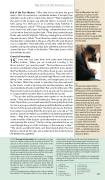
Paul and Barnabas tear their garments in response to the blasphemy of the people who worship them as gods, even o ering sacri ce to them. Paul tries to preach to them, showing them how God’s goodness is already at work in their lives, but the mission in Lystra ends badly: the Gentiles want to o er sacri ce to him as to a god, while the Jews stone him and leave him for dead.
15:1
The apostles and presbyters gather in Jerusalem to discuss the question of Jews and Gentiles in the Christian communities. Some feel that Gentiles should be circumcised, and thus bound to observe the entire Jewish law. Others believe that they need only follow the way of Jesus. This gathering is called the “Council of Jerusalem.” It is considered the rst council of the Church. Since then, there have been hundreds of Church councils, including
21 ecumenical (universal) councils. The most recent ecumenical Council was the Second Vatican Council (1962- 1965), so called because it was the second council held at the Vatican in Rome.
* [14:23] They appointed presbyters: the communities are given their own religious leaders by the traveling missionaries. The structure in these churches is patterned on the model of the Jerusalem community (Acts 11:30; 15:2, 5, 22; 21:18).
* [15:1–35] The Jerusalem “Council” marks the o cial rejection of the rigid view that Gentile converts were obliged to observe the Mosaic law completely. From here to the end of Acts, Paul and the Gentile mission become the focus of Luke’s writing.
* [15:1–5] When some of the converted Pharisees of Jerusalem discover the results of the rst missionary journey of Paul, they urge that the Gentiles be taught to follow the Mosaic law. Recognizing the authority of the Jerusalem church, Paul and Barnabas go there to settle the question of whether Gentiles can embrace a form of Christianity that does not include this obligation.
* [15:6–12] The gathering is possibly the same as that recalled by Paul in Gal 2:1–10. Note that in Acts 15:2 it is only the apostles
and presbyters, a small group, with whom Paul and Barnabas are to meet. Here Luke gives the meeting a public character because he wishes to emphasize its doctrinal signi cance (see Acts 15:22).
* [15:7–11] Paul’s refusal to impose the Mosaic law on the Gentile Christians is supported by Peter on the ground that within his own experience God bestowed the holy Spirit upon Cornelius and his household without preconditions concerning the adoption of the Mosaic law (see Acts 10:44–47).
* [15:11] In support of Paul, Peter formulates the fundamental meaning of the gospel: that all are invited to be saved through faith in the power of Christ.
CHAPTER 14
h. [14:22] 1 Thes 3:3. i. [14:26] 13:1–3.
CHAPTER 15
a. [15:1–4] Gal 2:1–9.
b. [15:1] Lv 12:3; Gal 5:2.
c. [15:7] 10:27–43.
d. [15:8] 10:44–48.
e. [15:9] 10:34–35.
f. [15:10] Mt 23:4; Gal 5:1. g. [15:11] Gal 2:16; 3:11; Eph 2:5–8.
267


