


Page 349 - Demo
P. 349
e ective application of means to achieve an end. The same term can designate the arts of building (cf. 1 Cor 3:10) or of persuasive speaking (cf. 1 Cor 2:4) or e ectiveness in achieving salvation. Eloquence (logos): this translation emphasizes one possible meaning of the term logos (cf. the references to rhetorical style and persuasiveness in 1 Cor 2:1, 4). But the term itself may denote an internal reasoning process, plan, or intention, as well as an external word, speech, or message. So by his expression ouk en sophia logou in the context of gospel preaching, Paul may intend to exclude both human ways of reasoning or thinking about things and human rhetorical technique. Human: this adjective does not stand in the Greek text but is supplied from the context. Paul will begin immediately to distinguish between sophia and logos from their divine counterparts and play them o against each other.
* [1:21–25] True wisdom and power are to be found paradoxically where one would least expect them, in the place of their apparent negation. To human eyes the cruci ed Christ symbolizes impotence and absurdity.
* [1:26–2:5] The pattern of God’s wisdom and power is exempli ed in their own experience, if they interpret it rightly (1 Cor 1:26–31), and can also be read in their experience of Paul as he rst appeared among them preaching the gospel (1 Cor 2:1–5).
* [1:29–31] “Boasting (about oneself )” is a Pauline expression for the radical sin, the claim to autonomy on the part of a creature, the illusion that we live and are saved by our own resources.“Boasting in the Lord”(1 Cor 1:31), on the other hand, is the acknowledgment that we live only from God and for God.
j. [1:17] 2:1, 4.
k. [1:18] 2:14 / Rom 1:16.
l. [1:19] Is 29:14.
m. [1:20] Is 19:12.
n. [1:22] Mt 12:38; 16:1 / Acts 17:18–21.
o. [1:23] 2:2; Gal 3:1 / Gal 5:11. p. [1:27] Jas 2:5.
q. [1:29] Eph 2:9.
r. [1:30] Rom 4:17 / 6:11; Rom 3:24–26; 2 Cor 5:21 / Eph 1:7; Col 1:14;
1 Thes 5:23.
s. [1:31] Jer 9:23; 2 Cor 10:17.
CORINTHIANS
human eloquence,* so that the cross of Christ might not be emptied of its meaning.j
Paradox of the Cross. 18The message of the cross is foolishness to those who are perishing, but to us who are being saved it is the power of God.k 19For it is written:
“I will destroy the wisdom of the wise,
and the learning of the learned I will set aside.”l
20Where is the wise one? Where is the scribe? Where is the debater of this age? Has not God made the wisdom of the world foolish?m 21* For since in the wisdom of God the world did not come to know God through wisdom, it was the will of God through the foolishness of the proclamation to save those who have faith. 22For Jews demand signs and Greeks look for wisdom,n 23but we proclaim Christ cruci ed, a stumbling block to Jews and foolishness to Gentiles,o 24but to those who are called, Jews and Greeks alike, Christ the
power of God and the wisdom of God. 25For the foolishness of God is wiser than human wisdom, and the weakness of God is stronger than human strength.
The Corinthians and Paul.* 26Consider your own calling, brothers. Not many of you were wise by human standards, not many were powerful, not many were of noble birth. 27Rather, God chose the foolish of the world to shame the wise, and God chose the weak of the world to shame the strong,p 28and God chose the lowly and despised of the world, those who count for nothing, to reduce to nothing those who are something, 29so that no human being might boast* before God.q 30It is due to him that you are in Christ Jesus, who became for us wisdom from God, as well as righteousness, sancti cation, and redemption,r 31so that, as it is written, “Whoever boasts, should boast in the Lord.”s
1:12
The divisions in Corinth relate to key leaders in the early Church—Paul, Cephas (Peter), and Apollos. Paul emphasizes that it is a mistake to focus
on the teacher instead of the message. It is not about who baptized them, but in whose name they were baptized: Christ is all in all.
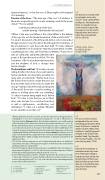
Christ on the Cross, by Odilon Redon (1840-1916)
1:22
The cross of Christ is power and paradox: the cross turns everything upside down. What seems foolishness is really the deepest wisdom. What seems weakness is really the greatest strength. In the words of the prophet Isaiah, “my thoughts are not your thoughts, / nor are your ways my ways” (55:8).
1:26
Paul tells the Corinthians to remember where they came from. They have nothing to brag about: their call was the free gift of God. If they boast, they should boast not of who they are or of what they have done, but of what God has done for them.
337


