


Page 352 - Demo
P. 352
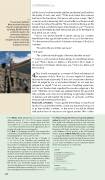
3:9 “You are God’s building.” When we think of the word “church,” we typically think of a building. But Paul reminds us that the church is the community of believers. He uses the building as a metaphor for the community, which is built on the foundation of Christ.
CORINTHIANS -
will disclose it. It will be revealed with re, and the re [itself ] will test the quality of each one’s work.f 14If the work stands that someone built upon the foundation, that person will receive a wage. 15But if someone’s work is burned up, that one will su er loss; the person will be saved,* but only as through re. 16Do you not know that you are the temple of God, and that the Spirit of God dwells in you?g 17If anyone destroys God’s temple, God will destroy that person; for the temple of God, which you are, is holy.*
18Let no one deceive himself. If anyone among you considers himself wise in this age, let him become a fool so as to become wise.h 19For the wisdom of this world is foolishness in the eyes of God, for it is written:i
“He catches the wise in their own ruses,” 20and again:
“The Lord knows the thoughts of the wise, that they are vain.”j
21* So let no one boast about human beings, for everything belongs to you,k 22Paul or Apollos or Cephas, or the world or life or death, or the present or the future: all belong to you, 23and you to Christ, and Christ to God.
41Thus should one regard us: as servants of Christ and stewards of a2
the mysteries of God. Now it is of course required of stewards that they be found trustworthy. 3It does not concern me in the least that I be judged by you or any human tribunal; I do not even pass judgment on myself; 4I am not conscious of anything against me, but I do not thereby stand acquitted; the one who judges me is the Lord.b 5Therefore, do not make any judgment before the appointed time, until the Lord comes, for he will bring to light what is hidden in darkness and will manifest the motives of our hearts, and then everyone will receive praise from God.
Paul’s Life as Pattern.* 6I have applied these things to myself and Apollos for your bene t, brothers, so that you may learn from us not to go beyond what is written,* so that none of you will be in ated with pride in favor of one person over against another. 7Who confers
* [3:15] Will be saved: although Paul can envision very harsh divine punishment (cf. 1 Cor 3:17), he appears optimistic about the success of divine corrective means both here and elsewhere (cf. 1 Cor 5:5; 11:32 [discipline]). The text of 1 Cor 3:15 has sometimes been used to support the notion of purgatory, though it does not envisage this.
* [3:17] Holy: i.e., “belonging to God.” The cultic sanctity of the community is a fundamental theological reality to which Paul frequently alludes (cf. 1 Cor 1:2, 30; 6:11; 7:14).
* [3:21–23] These verses pick up the line of thought of 1 Cor 1:10–13. If the Corinthians were genuinely wise (1 Cor 3:18–20), their perceptions would be reversed, and they would see everything in the world and all those with whom they exist in the church in their true relations with one another. Paul assigns all the persons involved in the theological universe a position on a scale: God, Christ, church members, church leaders. Read from top to bottom, the scale expresses ownership; read from bottom to top, the obligation to serve. This picture should be complemented by similar statements such as those in 1 Cor 8:6 and 1 Cor 15:20–28.
*[4:6–21] This is an emotionally charged peroration to the discussion about divisions. It contains several exhortations and statements of Paul’s purpose in writing (cf. 1 Cor 4:6, 14–17, 21) that counterbalance the initial exhortation at 1 Cor 1:10.
* [4:6] That you may learn from us not to go beyond what is written: the words “to go” are not in the Greek, but have here been added as the minimum necessary to elicit sense from this di cult passage. It probably means that the Corinthians should avoid the false wisdom of vain speculation, contenting themselves with Paul’s proclamation of the cross, which is the ful llment of God’s promises in the Old Testament (what is written). In ated with pride: literally, “pu ed up,” i.e., arrogant, lled with a sense of self-importance. The term is particularly Pauline, found in the New Testament only in 1 Cor 4:6, 18–19; 5:2; 8:1; 13:4; Col 2:18 (cf. the related noun at 2 Cor 12:20). It sometimes occurs in conjunction with the theme of “boasting,” as in 1 Cor 4:6–7 here.
CHAPTER 3
f. [3:13] Mt 3:11–12; 2 Thes 1:7–10.
g. [3:16] 6:19; 2 Cor 6:16; Eph 2:20–22. h. [3:18] 8:2; Is 5:21; Gal 6:3.
i. [3:19] 1:20 / Jb 5:13.
j. [3:20] Ps 94:11.
k. [3:21] 4:6 / Rom 8:32.
CHAPTER 4
a. [4:1] Ti 1:7; 1 Pt 4:10.
b. [4:4] 2 Cor 1:12 / Rom 2:16; 2 Cor 5:10.
340


