


Page 366 - Demo
P. 366
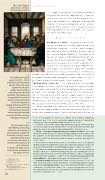
The Lord’s Supper, anonymous, Alsatian stained-glass window
11:17 Paul addresses liturgical issues in Corinth—that is, problems with the common worship. When they come together for the Lord’s Supper, the Corinthians each bring their own food and drink: thus the poor go hungry while the rich have plenty, and even get drunk. Economic inequality is leading to division within the Church, and Paul reminds the Corinthians that such divisions may be inevitable in society, but they can never tolerated in the Church.
11:23 This holy meal is about remembering and looking forward. It is a memorial of Christ’s passion, a prayer for his second coming. It means looking outward, to the community, and inward, to the heart and conscience of each individual. To “discern the body” means to recognize one another as the “body” of Christ.
h. [11:12] 8:6; Rom 11:36.
i. [11:18] 1:10–12; Gal 5:20.
j. [11:22] Jas 2:1–7.
k. [11:23] 11:2; 15:3 / 10:16–17; Mt 26:26–29;
Mk 14:22–25; Lk 22:14–20.
l. [11:25] Ex 24:8; 2 Cor 3:6; Heb 8:6–13.
m. [11:32] Dt 8:5; Heb 12:5–11.
354
* [11:13–16] The argument for conformity to common church practice is summed up and pressed home. 1 Cor 11:14–15 contain a nal appeal to the sense of propriety that contemporary Greek society would consider “natural” (cf. 1 Cor 11:5–6).
* [11:17–34] Paul turns to another abuse connected with the liturgy, and a more serious one, for it involves neglect of basic Christian tradition concerning the meaning of the Lord’s Supper. Paul recalls that tradition for them and reminds them of its implications.
* [11:19] That. . .those who are approved among you may become known: Paul situates their divisions within the context of the eschatological separation of the authentic from the inauthentic and the nal revelation of the di erence. The notion of authenticity- testing recurs in the injunction to self-examination in view of present and future judgment (1 Cor 11:28–32).
* [11:23–25] This is the earliest written account of the institution of the Lord’s Supper in the New Testament. The narrative emphasizes Jesus’ action of self-giving (expressed in the words over the bread and the cup) and his double command to repeat his own action.
* [11:27] It follows that the only proper way to celebrate the Eucharist is one that corresponds to Jesus’ intention, which ts with the meaning of his command to reproduce his action in the proper spirit. If the Corinthians eat and drink unworthily, i.e., without having grasped and internalized the meaning of his death for them, they will have to answer for the body and blood, i.e., will be guilty of a sin against the Lord himself (cf. 1 Cor 8:12).
* [11:28] Examine himself: the Greek word is similar to that for “approved” in 1 Cor 11:19, which means “having been tested and found true.” The self-testing required for proper eating involves discerning the body (1 Cor 11:29), which, from the context, must mean understanding the sense of Jesus’ death (1 Cor 11:26), perceiving the imperative to unity that follows from the fact that Jesus gives himself to all and requires us to repeat his sacri ce in the same spirit (1 Cor 11:18–25).
CORINTHIANS
13* Judge for yourselves: is it proper for a woman to pray to God with her head unveiled? 14Does not nature itself teach you that if a man wears his hair long it is a disgrace to him, 15whereas if a woman has long hair it is her glory, because long hair has been given [her] for a covering? 16But if anyone is inclined to be argumentative, we do not have such a custom, nor do the churches of God.
B. THE lORD’S SUPPER*
An Abuse at Corinth. 17In giving this instruction, I do not praise the fact that your meetings are doing more harm than good. 18First of all, I hear that when you meet as a church there are divisions among you, and to a degree I believe it;i 19there have to be factions among you in order that [also] those who are approved among you may become known.* 20When you meet in one place, then, it is not to eat the Lord’s supper, 21for in eating, each one goes ahead with his own supper, and one goes hungry while another gets drunk. 22Do you not have houses in which you
can eat and drink? Or do you show contempt for the church of God and make those who have nothing feel ashamed? What can I say to you? Shall I praise you? In this matter I do not praise you.j
Tradition of the Institution. 23* For I received from the Lord what I also handed on to you,k that the Lord Jesus, on the night he was handed over, took bread, 24and, after he had given thanks, broke it and said, “This is my body that is for you. Do this in remembrance of me.” 25In the same way also the cup, after supper, saying, “This cup is the new covenant in my blood. Do this, as often as you drink it, in remembrance of me.”l 26For as often as you eat this bread and drink the cup, you proclaim the death of the Lord until he comes.
27Therefore whoever eats the bread or drinks the cup of the Lord unworthily will have to answer for the body and blood of the Lord.* 28A person should examine himself,* and so eat the bread and drink the


