


Page 371 - Demo
P. 371
CORINTHIANS
Functions of These Gifts. 20* Brothers, stop being childish in your thinking. In respect to evil be like infants, but in your thinking be
d 21
mature. It is written in the law:
“By people speaking strange tongues and by the lips of foreigners
I will speak to this people,
and even so they will not listen to me,e
says the Lord.” 22Thus, tongues are a sign not for those who believe but for unbelievers, whereas prophecy is not for unbelievers but for those who believe.
23* So if the whole church meets in one place and everyone speaks in tongues, and then uninstructed people or unbelievers should come in, will they not say that you are out of your minds?f 24But if everyone is prophesying, and an unbeliever or uninstructed person should come in, he will be convinced by everyone and judged by everyone, 25and the secrets of his heart will be disclosed, and so he will fall down and worship God, declaring, “God is really in your midst.”g
Rules of Order. 26* So what is to be done, brothers? When you assemble, one has a psalm, another an instruction, a revelation, a tongue, or an interpretation. Everything should be done for building up.h 27If anyone speaks in a tongue, let it be two or at most three, and each in turn, and one should interpret. 28But if there is no interpreter, the person should keep silent in the church and speak to himself and to God.
29Two or three prophets should speak, and the others discern. 30But if a revelation is given to another
person sitting there, the rst one
should be silent. 31For you can all
prophesy one by one, so that all may learn and all be encouraged. 32Indeed, the spirits of prophets are under the prophets’ control, 33since he is not the God of disorder but of peace.
As in all the churches of the holy ones,* 34women should keep silent in the churches, for they are not allowed to speak, but should be subordinate, as even the law says.i 35But if they want
14:34
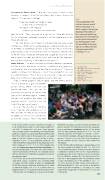
This passage about the silence of women would seem to contradict 11:5, which suggests that women did pray and prophecy in
the communal gatherings. Because of this contradiction, some scholars believe that this brief passage (14:34-
35) was added to the letter later on, to re ect the view
of women expressed in
I Timothy 2:11-12.
a. [14:1] 14:5, 12, 39.
b. [14:3] 14:4–5, 12, 17, 26; 3:9; 8:1, 10; 10:23.
c. [14:15] Eph 5:19; Col 3:16.
d. [14:20] Mt 10:16; Rom 16:19; Eph 4:14.
e. [14:21] Is 28:11–12; Dt 28:49.
f. [14:23] Acts 2:6, 13.
g. [14:25] 4:5 / Is 45:14; Zec 8:23.
h. [14:26] Eph 4:12.
i. [14:34] 1 Tm 2:11–15; 1 Pt 3:1.
*
[14:20–22] The Corinthians pride themselves on tongues as a sign of God’s favor, a means of direct communication with him (2:28). To challenge them to a more mature appraisal, Paul draws from scripture a less attering explanation of what speaking in tongues may signify. Isaiah threatened the people that if they failed to listen to their prophets, the Lord would speak to them (in punishment) through the lips of Assyrian conquerors (Is 28:11–12). Paul compresses Isaiah’s text and makes God address his people directly. Equating tongues with foreign languages (cf. 1 Cor 14:10–11), Paul concludes from Isaiah that tongues are a sign not for those who believe, i.e., not a mark of God’s pleasure for those who listen to him but a mark of his displeasure with those in the community who are faithless, who have not heeded the message that he has sent through the prophets.
[14:23–25] Paul projects the possible missionary e ect of two hypothetical liturgical experiences, one consisting wholly of tongues, the other entirely of prophecy. Uninstructed (idiōtai): the term may simply mean people who do not speak or understand tongues, as in 1 Cor 14:16, where it seems to designate Christians. But coupled with the term“unbelievers”it may be another way of designating those who have not been
initiated into the community of faith; some believe it denotes a special class of non-Christians who are close to the community, such as catechumens. Unbelievers (apistoi): he has shifted from the inner-community perspective of 1 Cor 14:22; the term here designates non-Christians (cf. 1 Cor 6:6; 7:15; 10:27). [14:26–33a] Paul concludes with speci c directives regarding exercise of the gifts in their assemblies. Verse 26 enunciates the basic criterion in the use of any gift: it must contribute to “building up.”
[14:33b–36] Verse 33b may belong with what precedes, so that the new paragraph would begin only with 1 Cor 14:34. 1 Cor 14:34–35 change the subject. These two verses have the theme of submission in common with 1 Cor 14:11 despite di erences in vocabulary, and a concern with what is or is not becoming; but it is di cult to harmonize the injunction to silence here with 1 Cor 11 which appears to take it for granted that women do pray and prophesy aloud in the assembly (cf. 1 Cor 11:5, 13). Hence the verses are often considered an interpolation, re ecting the discipline of later churches; such an interpolation would have to have antedated our manuscripts, all of which contain them, though some transpose them to the very end of the chapter.
359
*
*
*


