


Page 38 - Demo
P. 38
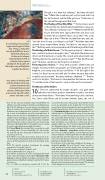
9:36 As word about Jesus spreads, large crowds begin to follow him. Seeing so many who are sick and a icted, Jesus is lled with compassion. He does not look upon the great human need as a burden, but as a great abundance. His disciples are the workers who will help him to gather this harvest.
10:1 Jesus shares his divine power with his disciples: the power to drive out demons and to heal all sicknesses and diseases. And he gives them a new name, “apostle,” which means “one who is sent.”
MATTHEW -
The girl is not dead but sleeping.”* And they ridiculed him. 25When the crowd was put out, he came and took her by the hand, and the little girl arose. 26And news of this spread throughout all that land.
The Healing of Two Blind Men.* 27j And as Jesus passed on from there, two blind men followed [him], crying out, “Son of David,* have pity on us!”k 28When he entered the house, the blind men approached him and Jesus said to them, “Do you believe that I can do this?” “Yes, Lord,” they said to him. 29Then he touched their eyes and said,
“Let it be done for you according to your faith.” 30And their eyes were opened. Jesus warned them sternly, “See that no one knows about this.” 31But they went out and spread word of him through all that land. The Healing of a Mute Person. 32l As they were going out,* a demoniac who could not speak was brought to him, 33and when the demon was driven out the mute person spoke. The crowds were amazed and said, “Nothing like this has ever been seen in Israel.”m 34* But the Pharisees said,n “He drives out demons by the prince of demons.”
The Compassion of Jesus. 35* o Jesus went around to all the towns and villages, teaching in their synagogues, proclaiming the gospel of the kingdom, and curing every disease and illness. 36p At the sight of the crowds, his heart was moved with pity for them because they were troubled and abandoned,* like sheep without a shepherd. 37* q Then he said to his disciples, “The harvest is abundant but the laborers are few; 38so ask the master of the harvest to send out laborers for his harvest.”
101* Then he summoned his twelve disciples* and gave them authority over unclean spirits to drive them out and to cure every disease and every illness.a 2The names of the twelve apostles* are these: first, Simon called Peter, and his brother Andrew; James, the son of
The Mission of the Twelve.
* [9:27–31] This story was probably composed by Matthew out of Mark’s story of the healing of a blind man named Bartimaeus (Mk 10:46–52). Mark places the event late in Jesus’ ministry, just before his entrance into Jerusalem, and Matthew has followed his Marcan source at that point in his gospel also (see Mt 20:29– 34). In each of the Matthean stories the single blind man of Mark becomes two. The reason why Matthew would have given a double version of the Marcan story and placed the earlier one here may be that he wished to add a story of Jesus’ curing the blind at this point in order to prepare for Jesus’ answer to the emissaries of the Baptist (Mt 11:4–6) in which Jesus, recounting his works, begins with his giving sight to the blind.
* [9:27] Son of David: this messianic title is connected once with the healing power of Jesus in Mark (Mk 10:47–48) and Luke (Lk 18:38–39) but more frequently in Matthew (see also Mt 12:23; 15:22; 20:30–31).
* [9:32–34] The source of this story seems to be Q (see Lk 11:14– 15). As in the preceding healing of the blind, Matthew has two versions of this healing, the later in Mt 12:22–24 and the earlier here.
* [9:34] This spiteful accusation foreshadows the growing opposition to Jesus in Mt 11 and 12.
* [9:35] See notes on Mt 4:23–25; Mt 8:1–9:38.
* [9:36] See Mk 6:34; Nm 27:17; 1 Kgs 22:17.
* [9:37–38] This Q saying (see Lk 10:2) is only imperfectly related
to this context. It presupposes that only God (the master of the harvest) can take the initiative in sending out preachers of the gospel, whereas in Matthew’s setting it leads into Mt 10 where Jesus does so.
*[10:1–11:1] After an introductory narrative (Mt 10:1–4), the
second of the discourses of the gospel. It deals with the mission now to be undertaken by the disciples (Mt 10:5–15), but the perspective broadens and includes the missionary activity of the church between the time of the resurrection and the parousia.
* [10:1] His twelve disciples: although, unlike Mark (Mk 3:13–14) and Luke (Lk 6:12–16), Matthew has no story of Jesus’ choosing the Twelve, he assumes that the group is known to the reader. The earliest New Testament text to speak of it is 1 Cor 15:5. The number probably is meant to recall the twelve tribes of Israel and implies Jesus’ authority to call all Israel into the kingdom. While Luke (Lk 6:13) and probably Mark (Mk 4:10, 34) distinguish between the Twelve and a larger group also termed disciples, Matthew tends to identify the disciples and the Twelve. Authority. . .every illness: activities the same as those of Jesus; see Mt 4:23; Mt 9:35; 10:8. The Twelve also share in his proclamation of the kingdom (Mt 10:7). But although he teaches (Mt 4:23; 7:28; 9:35), they do not. Their commission to teach comes only after Jesus’ resurrection, after they have been fully instructed by him (Mt 28:20).
* [10:2–4] Here, for the only time in Matthew, the Twelve are designated apostles. The word “apostle” means “one who is sent,” and therefore ts the situation here described. In the Pauline letters, the place where the term occurs most frequently in the New Testament, it means primarily one who has seen the risen Lord and has been commissioned to proclaim the resurrection. With slight variants in Luke and Acts, the names of those who belong to this group are the same in the four lists given in the New Testament (see note on Mt 9:9). Cananean: this represents an Aramaic word meaning“zealot.”The meaning of that designation is unclear (see note on Lk 6:15).
26
Chapter 9
j. [9:27–31] 20:29–34.
k. [9:27] 15:22.
l. [9:32–34] 12:22–24; Lk 11:14–15.
m. [9:33] Mk 2:12; 7:37. n. [9:34] 10:25; Mk 3:22. o. [9:35] 4:23; Lk 8:1.
p. [9:36] Nm 27:17; 1 Kgs 22:17; Jer 50:6; Ez 34:5; Mk 6:34.
q. [9:37–38] Lk 10:2; Jn 4:35.


