


Page 37 - Demo
P. 37
MATTHEW
and said, “Those who are well do not need a physician, but the sick do.* 13Go and learn the meaning of the words,f ‘I desire mercy, not sacrifice.’* I did not come to call the righteous but sinners.”
The Question About Fasting.
14g Then the disciples of John
approached him and said,
“Why do we and the Pharisees
fast [much], but your disciples
do not fast?” 15Jesus answered
them, “Can the wedding
guests mourn as long as the
bridegroom is with them? The days will come when the bridegroom
* 16
is taken away from them, and then they will fast. No one patches an
old cloak with a piece of unshrunken cloth,* for its fullness pulls away from the cloak and the tear gets worse. 17People do not put new wine into old wineskins. Otherwise the skins burst, the wine spills out, and the skins are ruined. Rather, they pour new wine into fresh wineskins, and both are preserved.”
The Official’s Daughter and the Woman with a Hemorrhage. 18* While he was saying these things to them,h an official* came forward, knelt down before him, and said, “My daughter has just died. But come, lay your hand on her, and she will live.” 19Jesus rose and followed him, and so did his disciples. 20A woman suffering hemorrhages for twelve years came up behind him and touched the tassel* on his cloak. 21She said to herself, “If only I can touch his cloak, I shall be cured.”i 22Jesus turned around and saw her, and said, “Courage, daughter! Your faith has saved you.” And from that hour the woman was cured.
23When Jesus arrived at the official’s house and saw the flute players and the crowd who were making a commotion, 24he said, “Go away!
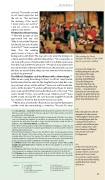
This painting by Pieter Brueghel the Elder (1529-1569) depicts a peasant wedding.
Jesus uses the image of a wedding banquet to describe the coming of the reign
of God. It is a time of joy, feasting, and ful llment. Christ the Bridegroom
“loved the Church as His bride, delivering Himself up for her.. He united her to Himself as His own body and brought it to perfection by the gift of the Holy Spirit for God’s glory” (Lumen Gentium, 39).
9:16
New cloth and new wine are metaphors for the newness of the kingdom of God, which has already begun with the coming of Christ. Even as centuries and millennia pass, Christ is always new. “Late have I loved you, O Beauty, ever ancient, ever new!”
(St. Augustine)
9:18
In these two miracle stories, touch is important. The woman reaches out to touch the tassel of Jesus’ cloak. Jesus reaches out his hand to touch the dead child. Healing and life ow from contact with Jesus.
25
* [9:13] Go and learn. . .not sacri ce: Matthew adds the prophetic statement of Hos 6:6 to the Marcan account (see also Mt 12:7). If mercy is superior to the temple sacri ces, how much more to the laws of ritual impurity.
* [9:15] Fasting is a sign of mourning and would be as inappropriate at this time of joy, when Jesus is proclaiming the kingdom, as it would be at a marriage feast. Yet the saying looks forward to the time when Jesus will no longer be with the disciples visibly, the time of Matthew’s church. Then they will fast: see Didache 8:1.
* [9:16–17] Each of these parables speaks of the unsuitability of attempting to combine the old and the new. Jesus’ teaching is not a patching up of Judaism, nor can the gospel be contained within the limits of Mosaic law.
* [9:18–34] In this third group of miracles, the rst (Mt 9:18–26) is clearly dependent on Mark (Mk 5:21–43). Though it tells of two miracles, the cure of the woman had already been included within the story of the raising of the o cial’s daughter, so that the two were probably regarded as a single unit. The other miracles seem to have been derived from Mark and Q, respectively, though there Matthew’s own editing is much more evident.
* [9:18] O cial: literally, “ruler.” Mark calls him “one of the synagogue o cials” (Mk 5:22). My daughter has just died: Matthew heightens the Marcan “my daughter is at the point of death” (Mk 5:23).
* [9:20] Tassel: possibly “fringe.” The Mosaic law prescribed that tassels be worn on the corners of one’s garment as a reminder to keep the commandments (see Nm 15:37–39; Dt 22:12).
* [9:24] Sleeping: sleep is a biblical metaphor for death (see Ps 87:6 LXX; Dn 12:2; 1 Thes 5:10). Jesus’ statement is not a denial of the child’s real death, but an assurance that she will be roused from her sleep of death.
Chapter 9
a. [9:1–8] Mk 2:3–12; Lk 5:18–26.
b. [9:2] Lk 7:48.
c. [9:6] Jn 5:27.
d. [9:9–13] Mk 2:14–17; Lk 5:27–32. e. [9:10] 11:19; Lk 15:1–2.
f. [9:13] 12:7; Hos 6:6.
g. [9:14–17] Mk 2:18–22; Lk 5:33–39. h. [9:18–26] Mk 5:22–43; Lk 8:41–56. i. [9:21] 14:36; Nm 15:37.


