


Page 9 - NYS_ESS_05-2026
P. 9
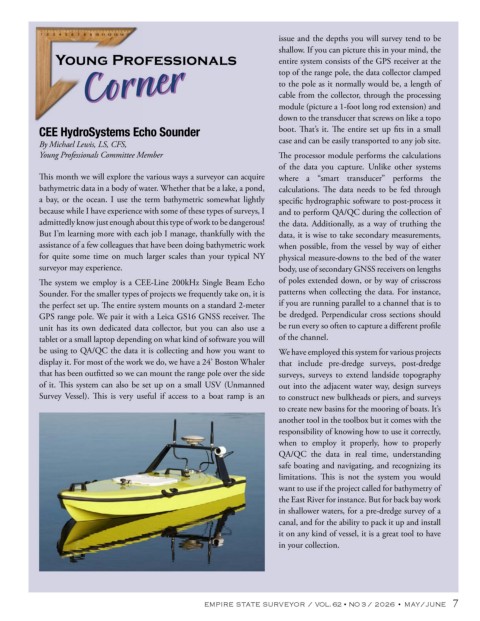
issue and the depths you will survey tend to be
                                                                        shallow. If you can picture this in your mind, the
               Young Professionals                                      entire system consists of the GPS receiver at the
                      Corner                                            top of the range pole, the data collector clamped
                       Corner
                       Corner
                                                                        to the pole as it normally would be, a length of
                                                                        cable from the collector, through the processing
                                                                        module (picture a 1-foot long rod extension) and
                                                                        down to the transducer that screws on like a topo
           CEE HydroSystems Echo Sounder                                boot. That’s it. The entire set up fits in a small
           By Michael Lewis, LS, CFS,                                   case and can be easily transported to any job site.
           Young Professionals Committee Member                         The processor module performs the calculations
                                                                        of the data you capture. Unlike other systems
           This month we will explore the various ways a surveyor can acquire   where  a  “smart  transducer”  performs  the
           bathymetric data in a body of water. Whether that be a lake, a pond,   calculations.  The  data  needs  to  be  fed  through
           a bay, or the ocean. I use the term bathymetric somewhat lightly   specific hydrographic software to post-process it
           because while I have experience with some of these types of surveys, I   and to perform QA/QC during the collection of
           admittedly know just enough about this type of work to be dangerous!   the data. Additionally, as a way of truthing the
           But I’m learning more with each job I manage, thankfully with the   data, it is wise to take secondary measurements,
           assistance of a few colleagues that have been doing bathymetric work   when possible, from the vessel by way of either
           for  quite  some time  on  much larger  scales  than your typical NY   physical measure-downs to the bed of the water
           surveyor may experience.                                     body, use of secondary GNSS receivers on lengths
           The system we employ is a CEE-Line 200kHz Single Beam Echo   of poles extended down, or by way of crisscross
           Sounder. For the smaller types of projects we frequently take on, it is   patterns when collecting the data. For instance,
           the perfect set up. The entire system mounts on a standard 2-meter   if you are running parallel to a channel that is to
           GPS range pole. We pair it with a Leica GS16 GNSS receiver. The   be dredged. Perpendicular cross sections should
           unit  has  its  own  dedicated  data  collector,  but  you  can  also  use  a   be run every so often to capture a different profile
           tablet or a small laptop depending on what kind of software you will   of the channel.
           be using to QA/QC the data it is collecting and how you want to   We have employed this system for various projects
           display it. For most of the work we do, we have a 24’ Boston Whaler   that include pre-dredge surveys, post-dredge
           that has been outfitted so we can mount the range pole over the side   surveys, surveys to extend landside topography
           of it. This system can also be set up on a small USV (Unmanned   out into the adjacent water way, design surveys
           Survey  Vessel). This is very useful if access to a boat ramp is an   to construct new bulkheads or piers, and surveys
                                                                        to create new basins for the mooring of boats. It’s
                                                                        another tool in the toolbox but it comes with the
                                                                        responsibility of knowing how to use it correctly,
                                                                        when to employ it properly, how to properly
                                                                        QA/QC the data in real time, understanding
                                                                        safe boating and navigating, and recognizing its
                                                                        limitations. This is not the system you would
                                                                        want to use if the project called for bathymetry of
                                                                        the East River for instance. But for back bay work
                                                                        in shallower waters, for a pre-dredge survey of a
                                                                        canal, and for the ability to pack it up and install
                                                                        it on any kind of vessel, it is a great tool to have
                                                                        in your collection.


                                                      EMPIRE STATE SURVEYOR / VOL. 62 • NO 3 / 2026 • MAY/JUNE   7

