


Page 13 - CA System 44 Dyslexia Alignment
P. 13
E ective Approaches for Teaching Students with Dyslexia
Content of Structured Literacy Instruction: What is Taught
Morphology
Morphology is the study of meaningful elements within words (morphemes). Students are taught to spell and learn the meanings of morphemes— pre xes, base elements, and su xes (both in ectional and derivational)—with the goal
of improved word identi cation, spelling, and vocabulary. Morphological awareness allows students to recognize patterns among related words (e.g., science, conscious, conscientious;  nish,  nite, in nite,  nal, de ne; decide, decision, concise, incisor, indecisive) based on their spellings, even when the pronunciation
of the morphemes may vary. Morphological awareness is associated with improved word identi cation, vocabulary, spelling, and reading comprehension (Berninger et al. 2010; Carlisle and Fleming 2003; Carlisle 2004; Henry 2010; Moats 2006, 2010; Nagy 2005; Nagy, Berninger, and Abbott 2006).
School Matters
System 44 Personalized Instructional Software and Teacher-Facilitated Instruction
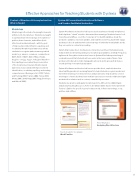
System 44 software and teacher-led lessons teach students to identify morphemes that help them “chunk” words to determine their meanings. Students learn to look for pre xes and a xes, count the “vowel spots” to identify syllables, break the words into syllables, read each syllable, and read the word. Thus, System 44 equips students to decode and determine the meanings of unfamiliar multisyllabic words they encounter in content area reading.
System 44 provides direct, multisensory, interactive teaching of individual words, independent word-learning strategies, morphological syllables, and high-frequency sight words. Every direct instruction lesson in System 44 includes preteaching of vocabulary words that students will encounter in the lesson and software. New words are introduced in small, manageable amounts and in groups that share a sound-spelling or morphological pattern.
System 44 software and teacher-led lessons provide direct, explicit instruction about splitting words into meaningful parts to help students recognize words and learn their meanings. Context sentences and pictures also help students connect meaning to content. Students have multiple exposures to new decodable and sight words both in isolation and, in context, cumulatively over time.
Students also practice and apply morphology in the 44Book, Decodable Digest, and Library Teaching Resources. Refer to the Master Skills Tracker in the System 44 Teacher’s Edition for speci c lessons for base words, in ectional endings, roots, pre xes, and su xes.
TEACH ACADEMIC VOCABULARY
READ TALK WRITE
W
Point out the changes in word beginnings and endings and the part of speech. We change the ending -ess of the noun success to -eed in the verb succeed. When we add the suffix -ful to the noun success, we form the adjective successful. These words are in the same word family.
2. Define Read the meaning and have students complete it in their 44Books. Then restate the meaning, asking students to complete it with the Target Word: To reach a goal is to  . (succeed)
3. Discuss Examples Read the frame and model a possible answer. Then have students share other ideas and record one.
Ask meaningful questions using RED Routine 4: Think-Pair-Share and response frames.
• How can you succeed in hitting a home run? I can succeed in hitting a home run by  .
• What qualities do successful people have? Qualities successful people have are  .
Positive Behavioral Support Respect
Model how to listen actively and reflect on the discussion during Think-Pair-Share.
• I can build on my classmates’ ideas in our discussion so that they know I listened carefully. I might say, “Have you thought about this quality that successful people have?”
Provide frames to help students respond to others’ ideas.
• Can you explain more about ?
School Matters 13
Word Families
Introduce the word family on page 13 with RED Routine 3: Teaching Vocabulary.
1. Pronounce Say the word and ask students to repeat it.
WComoplretde thFe maemaninigliaendsexamples for the Target Words.
Target Word
succeed
suc•ceed
(verb)
p. 25
Meaning Ex
to reach  • I a goal
amples
hope to succeed (at/in) at getting a role in
the play. (in earning all As this marking period)
• To succeed in school, students need to complete all assignments. (read well)
Word Strategies
Analyzing Word Structure
success
Target Word
successful
suc•cess•ful (adjective)
p. 14
012-013_S44NG_PS_M1_VOC.indd 13
012-013_S44NG_TS_M1_VOC.indd 13
Meaning
having the planned
result
Examples
• I know I have been successful when my parents congratulate me. (I win a medal at my swim meet)
• A successful reader reads with  uency. (learns many new words)
SCHOOL MATTERS 13
11/16/12 2
:55 PM
13
Teach Academic Vocabulary
Word Families
1/24/13 2:56 PM


