


Page 12 - CA System 44 Dyslexia Alignment
P. 12
E ective Approaches for Teaching Students with Dyslexia
Content of Structured Literacy Instruction: What is Taught
Syllables
Reading instruction includes the teaching of basic syllable types and syllable division conventions.
A syllable is a unit of pronunciation that includes one vowel phoneme—with or without surrounding consonant phonemes. All syllables that end in a vowel phoneme are open syllables.
The six basic syllable types, each type based on
its vowel grapheme—vowel spelling— within each syllable, were regularized by Noah Webster to justify his division of syllables in his 1806 dictionary.
However, English is a morphophonemic language that is stress-based, so pronunciation of polysyllabic words is primarily determined by placement of stress:
 nite, in nite, in nity,  nish, de ne, de nition
All of the words listed above derive from the
same base element (i.e., < ne>) and illustrate the important point, “We never know the pronunciation of a base until it lands in a word.”
In English, spoken language syllable divisions often do not coincide with the conventions for dividing written words into syllables. Awareness of syllables is an important consideration in reading instruction. The number of vowel phonemes in
a word usually indicates the number of spoken syllables. The recognition of the type of vowel grapheme and the vowel phoneme associated
with that vowel grapheme expedites accurate identi cation and correct pronunciation of longer, unfamiliar words—especially critical content words in academic text. Knowledge of syllable types (vowel graphemes—vowel spellings) helps students accurately read longer words because it allows them to systematically divide longer words into manageable “chunks” instead of attempting to read them letter by letter. The goal is to help students decode (read and pronounce) a word correctly so that it will be recognized and will trigger meaning association. These spelling conventions were invented to help readers decide how a word is pronounced, and they help students to know how to spell words—although knowledge of syllables alone is not su cient for being a good speller.
System 44 Personalized Instructional Software and Teacher-Facilitated Instruction
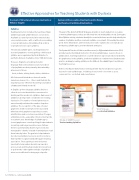
The goal of the System 44 Word Strategies strand is to teach students to recognize common syllable types so they can e ciently decode multisyllabic words. During the Word Splitter activity, students identify the vowel in the base word to help identify the number of syllables and then read each syllable or word part, followed by the whole word. In the Smart Zone, a Direct Instruction video explains key concepts about word parts, syllable types, and word attack strategies.
The System 44 Teacher’s Edition and Resources for Di erentiated Instruction (RDI) provide teacher-facilitated instruction for all six syllable types. Lessons focus on syllabication, teaching students to count the beats in a pronounced word, identify the graphemes in the syllables, and blend syllables to read the word. Students also practice and apply reading syllables in the 44Book, Decodable Digest, and Library Teaching Resources.
Refer to the Master Skills Tracker in the System 44 Teacher’s Edition for speci c lessons for each syllable type, including closed, vowel-consonant-e, open, consonant -le, r-controlled, and vowel teams.
MODULE 4
Do Now
S.M.A.R.T. Lesson
Student Objectives
Phonics Goals
• Identify vowel spots and syllables.
• Recognize that every syllable contains only one
vowel sound.
• Identify one-, two-, and three-syllable words. • Divide words into syllables.
READ TALK WRITE
During Whole-Group Introduction, have students match syllables to form multisyllable words:
Match the syllables to form words. Write them down.
• mu • ad • cab • pro • tick
• in
• gram • et
• sic
• mit
s.m.a.r.t. lesson
Understanding Syllables
Share responses with RED Routine 5: Idea Wave. Understanding Syllables
Cool!
Identify Vowel Spots
A long word is easier to read if you split it into syllables.
A syllable has only one vowel sound—called a vowel spot. A vowel spot may be spelled with more than one vowel.
Groov / y!
Fan / tas / tic!
During Small-Group Instruction, read aloud the examples at the top of the page and explain them using the
Word Building Kit.
• Define vowel spots. A vowel spot is the vowel sound in a syllable. A vowel spot is one sound, but it may be made up of a vowel team that has more than one letter, such aseeorai.
• Explain that you can use syllables to help you read long or unfamiliar words. The word cool has one vowel spot, so it has one syllable. The word groovy has two vowel spots, so it has two syllables. The word fantastic has three vowel spots, so it has three syllables.
Identify Vowel Spots
Model how to complete the activity.
• Read the first word aloud: truck, /t/, /r/, /u/, /k/. This
word has one vowel sound: /u/. This is called the vowel spot. Underline the letter u in truck.
• Build Understanding Echo read the rest of the words. Have students underline the vowel spots in each word. Remember that words often have more than one vowel spot. Listen for all of the vowel sounds when you read each word out loud.
Read each word. Underline each vowel spot in the word.
Word Strategies
r-controlled Syllables
1. truck
2. limitless 3. robin
4. happen
92 MODULE 4
5. plastic 6. habit 7. handful 8. cabinet
9. mess
10. dust
11. talentless
12. bonds
92 System 44 Module 4 092-093_S44NG_TU_M4_SL2.indd 92
1/25/13 1:04 PM
Module 4 SMART Lesson
Understanding Syllables
12 | hmhco.com/system44


