


Page 8 - CA System 44 Dyslexia Alignment
P. 8
E ective Approaches for Teaching Students with Dyslexia
Principles of Structured Literacy Instruction: How Structured Literacy is Taught
Sequential and Cumulative
Presentation of concepts and skills follows the logical order of the structure of the language. Instruction is sca olded and begins with teaching of the simple, most basic language concepts and elements and progresses systematically to more di cult and complex concepts and elements. Instruction in every lesson moves from teaching of skills to functional use and application of skills. New concepts are related to previously taught concepts, skills, and information—and presented in anticipation of future learning. Content must be mastered to the degree of automaticity needed to free attention and cognitive resources for comprehension and oral and written expression.
System 44 Personalized Instructional Software and Teacher-Facilitated Instruction
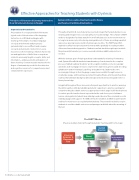
Throughout System 44, new material is presented in ways that help students process meaning and integrate new concepts with previous knowledge. The software’s FASTT model is designed to facilitate transfer from e ortful practice in short-term memory to long-term memory, by introducing manageable sets of items, providing repeated exposures, spacing review, and shortening response time. The FASTT algorithm expands recall by interspersing new elements with a gradually increasing number
of known elements during practice. Students can fast-track through topics in which they demonstrate mastery or receive new material when additional practice is needed.
With the ultimate goal of helping students understand the meaning of what they read, System 44 sca olds students toward mastery of each strand in the complex process of skilled reading. Students’ word recognition skills become increasingly automatic as they engage in lessons on phonemic awareness, phonics and decoding, syllabication and word analysis, spelling, and sight words. Students become increasingly strategic in their language comprehension skills through lessons in vocabulary, usage, and meaning, as well as through software activities and teaching routines that stimulate background knowledge and verbal reasoning and reinforce literacy knowledge.
Integrated throughout these lessons are frequent opportunities to practice weaving the skills together, ultimately building students’ capacities to practice reading and comprehending decodable sentences appropriate to their stage in skill development. A content-speci c transfer lesson is provided at the end of every set of software lessons, during which students view a background video and then read and record a related passage with support. The 44Book Teacher’s Edition and RDI include transfer routines for teachers to use regularly with students. These transfer activities require students to read decodable sentences and passages and think about the meaning of the text.
The FASTT Model
(Fluency and Automaticity through Systematic Teaching with Technology)
Guided Practice
Direct Instruction
Assess for Mastery
Universal Screener & Placement Tool
Independent Practice
Powered by
FASTT
8 | hmhco.com/system44
Adjust


