


Page 61 - DiVin022017
P. 61
myself, it‘s as crowded as a Japanese subway!“
At the slaughterhouse the pigs are put in a kind of lift. It takes them down into a chamber  lled with carbon dioxide gas. The gas stuns the animals before they are slit with a knife. A controversial method. It is always being reported in the press that the pigs certainly are afraid of death, that the anaesthetic works slowly - and they desperately gasp for air.
Guillermo González:
„The animals are often in the slaughterhouse for
a whole day. Of course, they are killed as humanely as possible - but it‘s still tough, for everyone. This is why many people here in Spain are vegetarians. But then you try this ham. And even if you feel bad about it - it‘s just too good!“
Guillermo sighs. And suddenly begins to gush
The sound tells him whether the ham has the consistency it should.
about ham. When it comes to ham, the animal rights activist in his heart must step aside, his passion for Jamón is just too big.
It is not only the pig breeder who decides how good a ham tastes. The animal can be very well fed and cared for but if the club doesn‘t mature properly, it‘s all in vain.
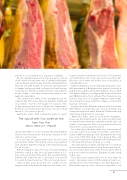
Rafael Chaparro gives the leg of a ham hanging from the ceiling a slap. He is an expert when it co- mes to the maturity of the ham. The sound tells him whether the ham has the consistency it should. If it sounds hollow, he worries. This one sounds good.
„These hams have been here for a while. It can happen that a  y  nds its way into the ham - th-
rough a small hole that we don‘t notice. Then worms can settle there. Of course, we try to save the ham. Because all of them are worth a lot; it would be a considerable loss.“
Rafael Chaparro runs the Bodega Chaparro in its  fth generation. A Bodega in this region is not just a pub, but also a place where ham matures. It is located in Cumbres Mayores, a village in the Sierra de Huelva, just 30 kilometres from Jabugo. The Chaparros are not the only ones in Cumbres Mayores who make their living from pigs. Half the village is in the ham business. At least.
Pig breeders like Eduardo entrust their best ham with Rafael. So that they are stored carefully and slowly develop their taste. Eduardo‘s Manchado pig clubs have hung here for six years.
„When the clubs come to us from the slaughter- house, we  rst take them to the salt room. We treat the meat for the  rst time only with salt. We also rub it with oil and grease. This is to prevent bacteria or mites from colonising in the meat.
For a few days, the ham clubs lie in a mountain of sea salt. Later, they hang for months, sometimes years, in different drying rooms. During this time, they lose a lot of fat that drips to the ground. They can lose up to half of their weight like this. Rafael points to the drops that have formed on a club.
„The ham will never taste optimal if it is not taken at its ideal ripening time. A very fresh ham has al- most no taste! At least not the intense taste that a real acorn ham should have. Eduardo‘s hams hang in this row.“
They have been parked here for no less than six years - like luxury cars in a VIP parking lot, well-se- parated from the mid-range cars. But Eduardo‘s Manchado pigs are also easily recognisable - by
61


