


Page 62 - DiVin022017
P. 62
their hooves of course:
„Look, the leg here has a white hoof, for example.
And here is the organic label and the certi cate for the protected designation of origin - all of this gives the product its added value.“
The designation of origin refers to the ham‘s region, Sierra de Huelva. This „Denominación de Origen“, as it is called here, has existed for 20 years. She resides in an old manor house on the outskirts of Jabugo.
Her director, José Antonio Pavón, wants to change the name of the designation of origin. The quality ham will no longer be called „Huelva ham“, but „Ja- bugo ham“. Because no Spaniard has any idea about Huelva ham, but every child in this country has heard of Jabugo ham. „Jabugo“ is an established brand - and therein lies a problem:
„Because the term Jabugo is not protected, anyo- ne in the world can call their ham Jabugo ham. You could found a company in Germany tomorrow and sell Jabugo ham. That strikes me as obscene! But you can do it! All you have to do is write ‚Jabugo‘ on your ham and you can sell it at a higher price!“
There is a lot of money in the ham business. Iberian ham always sells better - even internationally. And the region has long been the focus of the big meat producers. The breeders are concerned that their name is being misused. That‘s why Pavón is trying to establish a new brand. And
celebrates the whole thing accordingly. José loves exactly that.
„It might be a private party at someone‘s home. Or a family that wants to celebrate intimately without being disturbed - perhaps on a ship or a yacht. You can order me for such occasions anywhere, all over the world. Usually we are travelling in Europe. But I‘ve also been  own in to Colombia and Miami, for example.“
A professional ham slicer like José costs about 1,500 euros per night. The exact price depends on how big the event is and how many guests are the- re. Plus, of course, the cost of air travel and hotel accommodation.
José demonstrates his skills in Jacinto‘s restau- rant, an old friend of his - no large sums of money are  owing here today. Jacinto has worked in gast- ronomy all his life and has been slicing ham for the past 40 years.
„But I can‘t do it as well as him, not as beautiful. I have to do it quickly. With him, it‘s art. The masters have learnt techniques that make cutting an art. It‘s not easy, it is very dif cult.“
The art begins: José  rst cuts the outer layers of fat from the ham, they are not edible. Then he stretches the leg on a ham stand, a wooden frame, and screws it tightly. Now José pulls out his sharp slicing knife
to convince the breeders from the area to join his initiative. A Jabugo ham will in future meet thehighestqualityrequirements - really only be the best of the best.
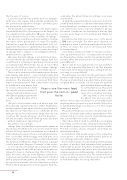
Acorns are the main food that give the ham its good taste.
with a  exible blade and begins to cut the  rst slices. They can‘t be too thick nor too thin - and also not too small nor too large.
„We go to the breeders and look at the pigs. Are they already registered by the state? Regardless, we will register them again. Are the pigs purebred? No, they‘re not? Then there is no certi cate. Do the animals eat acorns exclusively? Okay ,then we can continue. We decide when we visit the breeders - not the breeders. And we‘ll show up when we want - without making an appointment!“
The perfect slice of ham
Jabugo ham. José Abellán‘s eyes begin to gleam at this phrase. The Mallorcan is in shorts and a T-shirt in front of Casa Jacinto, a restaurant in a suburb of Palma. Before he enters, there‘s a small transforma- tion: José takes off the baggy shirt and puts on a black chef‘s jacket. It looks classy, embroidered with the Spanish and Balearic  ags. It also has a golden coat of arms with „Maestro Cortador“ in the centre.
José is a professional ham slicer and is part of the exclusive group of about 25 people in Spain who are allowed to bear a championship title in this disci- pline. He is the only one in the Balearic Islands. His customers are treated to luxury. They aren‘t satis ed with a prepared ham platter at a party - it must be by a professional who cuts the ham from a club in front of them and presents it to the guests. And also
„We say that a slice should be about four by four centi- metres. If you only cut a tiny slice, you hardly taste anything when you put it in your mouth. If the slice is signi cantly larger, you have to cut it  rst to get
it into your mouth.“
The perfect thickness of a slice of ham is two mil-
limetres - the taste takes effect optimally then. This includes fat for José. He doesn‘t understand people who cut the fat from a slice of ham.
„This taboo that it‘s bad to eat fat does not apply here. Many scientists have already shown that the fat in Iberico ham is good. It even promotes health. This fat consists of pure omega-3 acids that are absolutely healthy.“
A statement that would surely not be signed by every doctor - at least not without the proviso to not eat huge amounts of Iberico ham.
Iberico ham is a basic food in Spain but also a luxury product. A product that animates both gourmets and freaks as well as fraudsters and pro teers. Like a good Spanish wine, the ham is also a product that requires experience and knowledge - in the production as well as the enjoyment of it. The world of Iberico ham is a culinary cosmos that you can lose yourself in. And that makes for a hog-wild time!
62


