


Page 102 - 2021 April 1, ART OF THE ISLAMIC AND Indian Worlds Including Oriental Rugs, Christie's London
P. 102
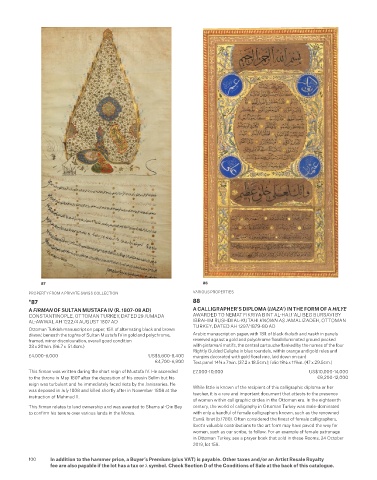
87                                                 88
          PROPERTY FROM A PRIVATE SWISS COLLECTION            VARIOUS PROPERTIES
          *87                                                 88
          A FIRMAN OF SULTAN MUSTAFA IV (R. 1807-08 AD)       A CALLIGRAPHER'S DIPLOMA (IJAZA') IN THE FORM OF A HILYE
          CONSTANTINOPLE, OTTOMAN TURKEY, DATED 29 JUMADA     AWARDED TO NEMAT FIKRIYA BINT AL-HAJJ 'ALI BEG BURSAVI BY
          AL-AWWAL AH 1222/4 AUGUST 1807 AD                   IBRAHIM RUSHDI AL-KUTAHI KNOWN AS JAMALIZADEH, OTTOMAN
                                                              TURKEY, DATED AH 1297/1879-80 AD
          Ottoman Turkish manuscript on paper, 15ll. of alternating black and brown
          diwani, beneath the tughra of Sultan Mustafa IV in gold and polychrome,   Arabic manuscript on paper, with 18ll. of black thuluth and naskh in panels
          framed, minor discolouration, overall good condition  reserved aganst a gold and polychrome floral illuminated ground pricked
          38 x 20¿in. (96.7 x  51.4cm.)                       with çintamani motifs, the central cartouche flanked by the names of the four
                                                              Rightly Guided Caliphs in blue roundels, within orange and gold rules and
          £4,000-6,000                          US$5,600-8,400  margins decorated with gold floral vine, laid down on card
                                                  €4,700-6,900  Text panel 14¬ x 7ºin. (37.2 x 18.5cm.); folio 18Ω x 11¬in. (47 x 29.5cm.)
          This firman was written during the short reign of Mustafa IV. He ascended   £7,000-10,000   US$10,000-14,000
          to the throne in May 1807 after the deposition of his cousin Selim but his                 €8,200-12,000
          reign was turbulent and he immediately faced riots by the Janissaries. He
                                                              While little is known of the recipient of this calligraphic diploma or her
          was deposed in July 1808 and killed shortly after in November 1808 at the
                                                              teacher, it is a rare and important document that attests to the presence
          instruction of Mahmud II.
                                                              of women within calligraphic circles in the Ottoman era. In the eighteenth
          This firman relates to land ownership and was awarded to Shams al-Din Bey   century, the world of calligraphy in Ottoman Turkey was male-dominated
          to confirm his tenure over various lands in the Morea.  with only a handful of female calligraphers known, such as the renowned
                                                              Esmâ Ibret (b.1780). Often considered the finest of female calligraphers,
                                                              Ibret's valuable contributions to the art form may have paved the way for
                                                              women, such as our scribe, to follow. For an example of female patronage
                                                              in Ottoman Turkey, see a prayer book that sold in these Rooms, 24 October
                                                              2019, lot 158.

          100    In addition to the hammer price, a Buyer’s Premium (plus VAT) is payable. Other taxes and/or an Artist Resale Royalty
                 fee are also payable if the lot has a tax or λ symbol. Check Section D of the Conditions of Sale at the back of this catalogue.

