


Page 111 - 2021 April 1, ART OF THE ISLAMIC AND Indian Worlds Including Oriental Rugs, Christie's London
P. 111
■*101
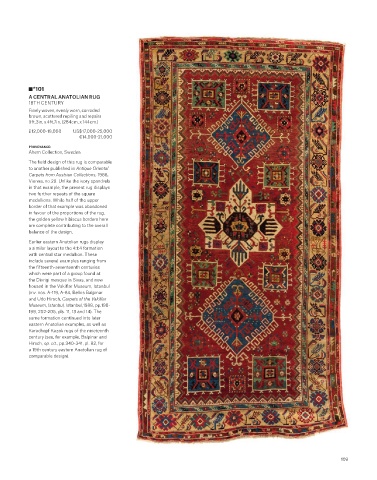
          A CENTRAL ANATOLIAN RUG
          18TH CENTURY
          Finely woven, evenly worn, corroded
          brown, scattered repiling and repairs
          9ft.3in. x 4ft.7in. (284cm. x 144cm.)
          £12,000-18,000   US$17,000-25,000
                          €14,000-21,000
          PROVENANCE:
          Ahern Collection, Sweden
          The field design of this rug is comparable
          to another published in Antique Oriental
          Carpets from Austrian Collections, 1986,
          Vienna, no.29. Unlike the ivory spandrels
          in that example, the present rug displays
          two further repeats of the square
          medallions. While half of the upper
          border of that example was abandoned
          in favour of the proportions of the rug,
          the golden yellow hibiscus borders here
          are complete contributing to the overall
          balance of the design.
          Earlier eastern Anatolian rugs display
          a similar layout to the 4:1:4 formation
          with central star medallion. These
          include several examples ranging from
          the fifteenth-seventeenth centuries
          which were part of a group found at
          the Divrigi mosque in Sivas, and now
          housed in the Vakiflar Museum, Istanbul
          (inv. nos. A-119, A-84, Belkis Balpinar
          and Udo Hirsch, Carpets of the Vakiflar
          Museum, Istanbul, Istanbul,1988, pp.198-
          199, 202-205, pls. 11, 13 and 14). The
          same formation continued into later
          eastern Anatolian examples, as well as
          Karachopf Kazak rugs of the nineteenth
          century (see, for example, Balpinar and
          Hirsch, op. cit., pp.340-341, pl. 82, for
          a 19th century eastern Anatolian rug of
          comparable design).


                                                                                                             109

