


Page 138 - 2021 April 1, ART OF THE ISLAMIC AND Indian Worlds Including Oriental Rugs, Christie's London
P. 138
VARIOUS PROPERTIES
                                      ■*130
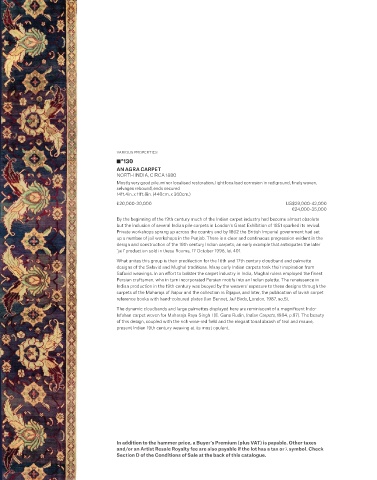
                                      AN AGRA CARPET
                                      NORTH INDIA, CIRCA 1880
                                      Mostly very good pile, minor localised restoration, light localised corrosion in red ground, finely woven,
                                      selvages rebound, ends secured
                                      14ft.4in. x 11ft.8in. (440cm. x 360cm.)
                                      £20,000-30,000                                       US$29,000-42,000
                                                                                             €24,000-35,000
                                      By the beginning of the 19th century much of the Indian carpet industry had become almost obsolete
                                      but the inclusion of several Indian pile carpets in London’s Great Exhibition of 1851 sparked its revival.
                                      Private workshops sprang up across the country and by 1862 the British Imperial government had set
                                      up a number of jail workshops in the Punjab. There is a clear and continuous progression evident in the
                                      design and construction of the 19th century Indian carpets; an early example that anticipates the later
                                      ‘jail’ production sold in these Rooms, 17 October 1996, lot 401.
                                      What unites this group is their predilection for the 16th and 17th century cloudband and palmette
                                      designs of the Safavid and Mughal traditions. Many early Indian carpets took their inspiration from
                                      Safavid weavings. In an effort to bolster the carpet industry in India, Mughal rulers employed the finest
                                      Persian craftsmen, who in turn incorporated Persian motifs into an Indian palette. The renaissance in
                                      Indian production in the 19th century was buoyed by the weavers' exposure to these designs through the
                                      carpets of the Maharaja of Jaipur and the collection in Bijapur, and later, the publication of lavish carpet
                                      reference books with hand-coloured plates (Ian Bennet, Jail Birds, London, 1987, no.5).
                                      The dynamic cloudbands and large palmettes displayed here are reminiscent of a magnificent Indo-
                                      Isfahan carpet woven for Maharaja Raya Singh I (E. Gans Rudin, Indian Carpets, 1984, p.87). The beauty
                                      of this design, coupled with the rich wine-red field and the elegant tonal abrash of teal and mauve,
                                      present Indian 19th century weaving at its most opulent.


                                      In addition to the hammer price, a Buyer’s Premium (plus VAT) is payable. Other taxes
                                      and/or an Artist Resale Royalty fee are also payable if the lot has a tax or λ symbol. Check
                                      Section D of the Conditions of Sale at the back of this catalogue.
          136

