


Page 40 - 2021 April 1, ART OF THE ISLAMIC AND Indian Worlds Including Oriental Rugs, Christie's London
P. 40
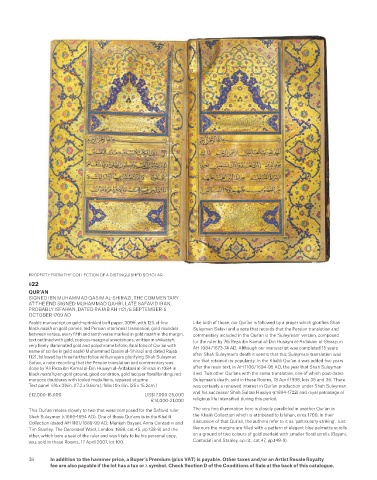
PROPERTY FROM THE COLLECTION OF A DISTINGUISHED SCHOLAR
          θ22
          QUR’AN
          SIGNED IBN MUHAMMAD QASIM AL-SHIRAZI, THE COMMENTARY
          AT THE END SIGNED MUHAMMAD QAHRI, LATE SAFAVID IRAN,
          PROBABLY ISFAHAN, DATED RAJAB AH 1121/6 SEPTEMBER-5
          OCTOBER 1709 AD
          Arabic manuscript on gold-sprinkled buff paper, 309ff. with 12ll. of fine   Like both of those, our Qur’an is followed by a prayer which glorifies Shah
          black naskh on gold panels, red Persian interlinear translation, gold roundels   Sulayman Safavi and a note that records that the Persian translation and
          between verses, every fifth and tenth verse marked in gold naskh in the margin,   commentary included in the Qur’an is the ‘Suleymani’ version, composed
          text outlined with gold, copious marginal annotations, written in shikasteh,   for the ruler by ‘Ali Reza ibn Kamal al-Din Husayni al-Ardakani al-Shirazi in
          very finely illuminated gold and polychrome bifolio, final folio of Qur'an with   AH 1084/1673-74 AD. Although our manuscript was completed 15 years
          name of scribe in gold naskh Muhammad Qasim al-Shirazi and dated Rajab
          1121, followed by three further folios with prayers glorifying Shah Sulayman   after Shah Suleyman’s death it seems that this Suleymani translation was
          Safavi, a note recording that the Persian translation and commentary was   one that retained its popularity. In the Khalili Qur’an it was added five years
          done by 'Ali Reza ibn Kamal al-Din Husayn al-Ardakani al-Shirazi in 1084 in   after the main text, in AH 1106/1694-95 AD, the year that Shah Suleyman
          black nasta'liq on gold ground, good condition, gold lacquer floral binding, red   died. Two other Qur’ans with the same translation, one of which post-dates
          morocco doublures with tooled medallions, repaired at spine  Suleyman’s death, sold in these Rooms, 18 April 1998, lots 35 and 36. There
          Text panel  6¾ x 3¾in. (17.2 x 9.6cm.); folio 10 x 6in. (25 x 15.2cm.)  was certainly a renewed interest in Qur’an production under Shah Suleyman
                                                              and his successor Shah Sultan Husayn (r.1694-1722) and royal patronage of
          £12,000-18,000                       US$17,000-25,000
                                                 €14,000-21,000  religious life intensified during this period.
                                                              The very fine illumination here is closely paralleled in another Qur’an in
          This Qur’an relates closely to two that were composed for the Safavid ruler
                                                              the Khalili Collection which is attributed to Isfahan, circa 1700. In their
          Shah Sulayman (r.1666-1694 AD). One of those Qur’ans is in the Khalili
                                                              discussion of that Qur’an, the authors refer to it as ‘particularly striking’. Just
          Collection (dated AH 1101/1689-99 AD; Manijeh Bayani, Anna Contadini and
                                                              like ours the margins are filled with a pattern of elegant blue palmette scrolls
          Tim Stanley, The Decorated Word, London, 1999, cat.45, pp.138-9) and the
                                                              on a ground of two colours of gold overlaid with smaller floral scrolls (Bayani,
          other, which bore a seal of the ruler and was likely to be his personal copy,
                                                              Contadini and Stanley, op.cit., cat.47, pp.148-9).
          was sold in these Rooms, 17 April 2007, lot 100.
          38     In addition to the hammer price, a Buyer’s Premium (plus VAT) is payable. Other taxes and/or an Artist Resale Royalty
                 fee are also payable if the lot has a tax or λ symbol. Check Section D of the Conditions of Sale at the back of this catalogue.

