


Page 4 - 2017_HNO_IRQ_web_Neat
P. 4
PART I: HUMANITARIAN NEEds & kEy fIgUREs


           HUMANITARIAN


          NEEds &


          kEy fIgUREs


          Three years of continuous conflict and economic stagnation have impacted nearly every aspect
          of Iraqi society. More people are vulnerable and in need of assistance now than at any time
          during the previous years. During 2017, humanitarians estimate that as many as 11 million
          Iraqis will require some form of humanitarian assistance. This figure represents the aggregate,
          rather than absolute number of people who will require some form of assistance. In some
          cases, a single person is counted several times in determining the overall level of need. This
          reflects the complex reality of Iraq and the changing vulnerabilities many Iraqis are expected
          to experience during the year.

          Partners estimate that up to 4.2 million internally displaced  communities and 1.4 million Iraqis living in newly retaken
          people may need assistance. Of these, 1.1 million are expected  areas, including 800,000 people in Mosul city and 600,000
          to be resident in camps and emergency sites and 3.1 million to  in  surrounding  areas,  are  expected  to  require  assistance.  Up
  04      live in host communities. Partners also estimate that 1.9 million  to 300,000 people are expected to remain in areas outside
          returnees will require assistance including 1.5 million people  Government control for at least a portion of the year, primarily
          who are expected to return at some point during the year  in western Anbar and 230,000 Syrian refugees are expected to
          and 400,000 of the 1.2 million who have already returned  remain in Iraq and to require continuing assistance.
          home in previous years. At least 3 million Iraqis living in host


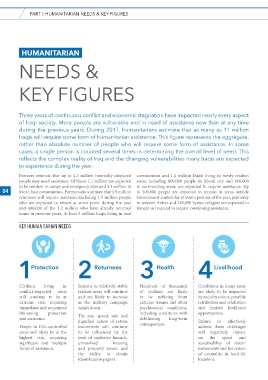
          KEY HUMANITARIAN NEEDS


         1                         2       Returnees           3       Health            4      Livelihood
               Protection


          Civilians  living  in     Returns to relatively stable   Hundreds of thousands   Conditions in many areas
          conflict-impacted  areas  retaken areas will continue   of civilians are likely   are likely to be impacted
          will continue to be at    and are likely to increase   to be suffering from    by social tensions, possible
          extreme  risk,  requiring   as the military campaign   extreme trauma and other   retribution and retaliation
          immediate and sequenced   winds down.                psychosocial conditions,   and limited livelihood
          life-saving  protection   The size, speed, safe and   including conditions with   opportunities.
          and assistance.                                      debilitating  long-term
                                    dignified  nature  of  return                        Failure  to  effectively
          People in ISIL-controlled   movements will continue   consequences.            address these challenges
          areas will likely be at the   to be influenced by the                          will  negatively  impact
          highest risk, requiring   level of explosive hazards,                          on   the   speed  and
          significant and multiple   unresolved    housing                               sustainability of return
          forms of assistance.      and property issues and                              movements and the return
                                    the  ability  to  obtain                             of normality in hard-hit
                                    identification papers.                               locations.

