


Page 200 - JAPN1001
P. 200
2 Contrasting が vs. を
In transitive sentences, the subject is marked with が and the object is marked with を. Below
are the typical meanings of the subject and the object:
1. が subject marker: in an active sentence, the subject typically is an agent, like a person/animal/thing which does something
2. を direct object marker: people/animals/things which are affected
Unlike English, the order of the subject and the object is irrelevant in Japanese, because が and
を move with appropriate noun phrases.
or
Doer Target
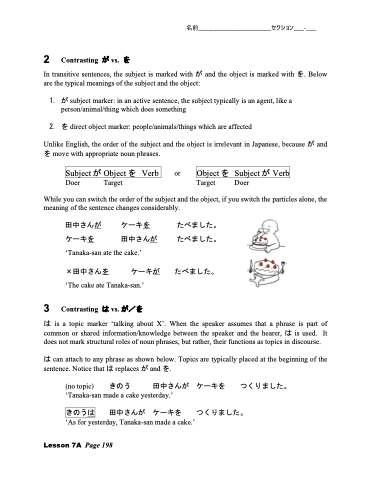
While you can switch the order of the subject and the object, if you switch the particles alone, the meaning of the sentence changes considerably.
名前_____________________________セクション____-____
      Subject が Object を Verb
Object を Subject が Verb
  Target Doer
 田中さんが ケーキを ケーキを 田中さんが ‘Tanaka-san ate the cake.’
×田中さんを ケーキが
‘The cake ate Tanaka-san.’
3 Contrasting は vs. が/を
たべました。
たべました。
たべました。
       は is a topic marker ‘talking about X’. When the speaker assumes that a phrase is part of common or shared information/knowledge between the speaker and the hearer, は is used. It does not mark structural roles of noun phrases, but rather, their functions as topics in discourse.
は can attach to any phrase as shown below. Topics are typically placed at the beginning of the sentence. Notice that は replaces が and を.
(no topic) きのう 田中さんが ケーキを つくりました。 ‘Tanaka-san made a cake yesterday.’
         田中さんが ケーキを  つくりました。
‘As for yesterday, Tanaka-san made a cake.’
   きのうは
  Lesson 7A Page 198


