


Page 36 - teachers.PDF
P. 36
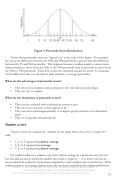
Figure 3. Percentile Score Distribution
Notice that percentiles are more "spread out" at the ends of the figure. For example, the raw score difference between the 95th and 90th percentile is greater than the difference between the 55 and 50th percentile. This happens because a student needs to answer more items correctly to move from the 90th to the 95th percentile than is necessary to move from the 50th to 55th percentile. Therefore, scores are clustered around the mean. It is because of this difference that you should not add, subtract, or average percentiles.
What are the advantages of percentile scores?
• They show how students rank in relation to the national or local average.
• They are easy to explain.
What are the limitations of percentile scores?
• They can be confused with total percent correct scores.
• They are not as accurate as they appear to be.
• They are often used inappropriately to compute group statistics or to determine
gains.
• They are frequently misunderstood.
Stanine scores
Stanine is short for standard nine. Stanine scores range from a low of 1 to a high of 9 with:
• 1, 2, or 3 representing below average
• 4, 5, or 6 representing average
• 7, 8, or 9 representing above average.
If a student achieves a stanine score that is below average in a particular area, the test
has revealed an area in which the student may need to improve -- or at least it reveals an
area in which the student is weak when compared to other students who took the test. If the
Rudner, L. and W. Schafer (2002) What Teachers Need to Know About Assessment. Washington, DC: National Education Association.
From the free on-line version. To order print copies call 800 229-4200
student achieves an average stanine score, the test has revealed that the student performed
31


