


Page 37 - teachers.PDF
P. 37
at the same level as most of the other students who took the test. Similarly, if the student achieves a stanine score that is above average, the test revealed that the student performed better in that area than most of the other students who took the test.
Stanines are frequently used as a basis for grouping students. For example, an advanced mathematics class may enroll students in the 9th, 8th, and sometimes 7th stanine.
How are stanine scores distributed?
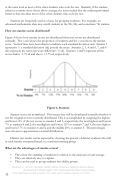
Figure 4 shows how stanine scores are distributed when raw scores are distributed normally. The y axis shows the proportion of students and the x axis shows the stanine score. Vertical lines have been drawn to indicate each standard deviation unit. Stanine 5 represents 1⁄2 a standard deviation (sd) around the mean. Stanines 2, 3, 4 and 6, 7, and 8 also represent the same raw score difference (1⁄2 sd). Stanines 1 and 9 represent all the scores below -1.75 sd and above +1.75 sd, respectively.
Figure 4. Stanines
Stanine scores are normalized. This means they will be distributed normally whether or not the original test was normally distributed. This is accomplished by assigning the highest and lowest 4% of the test scores to stanine 9 and 1, respectively; the next highest and lowest 7% to stanines 8 and 2; the nexthighest and lowest 12% to stanines 7 and 3, the next highest and lowest 17% to stanines 6 and 4, and the middle 20% to stanine 5. The percentages were chosen to approximate a normal distribution.
District test results can be reported by showing the percent of district students who fall in each stanine computed based on a national norming group.
What are the advantages of stanine scores?
32
• • •
They show the standing of students in relation to the national or local average. They are relatively easy to explain.
They can be used to group students into ability groups.
Rudner, L. and W. Schafer (2002) What Teachers Need to Know About Assessment. Washington, DC: National Education Association.
From the free on-line version. To order print copies call 800 229-4200


