


Page 84 - teachers.PDF
P. 84
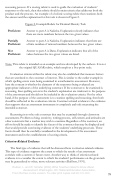
reasoning process. If a scoring rubric is used to guide the evaluation of students' responses to this task, then that rubric should contain criteria that addresses both the product and the process. An example of a holistic scoring rubric that examines both the answer and the explanation for this task is shown in Figure 2.
Proficient:
Partially Proficient:
Not Proficient:
Figure 2. Example Rubric for Decimal Density Task
Answer to part A is Nakisha. Explanation clearly indicates that there are more numbers between the two given values.
Answer to part A is Nakisha. Explanation indicates that there are a finite number of rational numbers between the two given values.
Answer to part A is Dana. Explanation indicates that all of the values between the two given values are listed.
Note. This rubric is intended as an example and was developed by the authors. It is not the original QUASAR rubric, which employs a five-point scale.
Evaluation criteria within the rubric may also be established that measure factors that are unrelated to the construct of interest. This is similar to the earlier example in which spelling errors were being examined in a mathematics assessment. However, here the concern is whether the elements of the responses being evaluated are appropriate indicators of the underlying construct. If the construct to be examined is reasoning, then spelling errors in the student's explanation are irrelevant to the purpose of the assessment and should not be included in the evaluation criteria. On the other hand, if the purpose of the assessment is to examine spelling and reasoning, then both should be reflected in the evaluation criteria. Construct-related evidence is the evidence that supports that an assessment instrument is completely and only measuring the intended construct.
Reasoning is not the only construct that may be examined through classroom assessments. Problem solving, creativity, writing process, self-esteem, and attitudes are other constructs that a teacher may wish to examine. Regardless of the construct, an effort should be made to identify the facets of the construct that may be displayed and that would provide convincing evidence of the students' underlying processes. These facets should then be carefully considered in the development of the assessment instrument and in the establishment of scoring criteria.
Criterion-Related Evidence
The final type of evidence that will be discussed here is criterion-related evidence. This type of evidence supports the extent to which the results of an assessment correlate with a current or future event. Another way to think of criterion-related evidence is to consider the extent to which the students' performance on the given task may be generalized to other, more relevant activities (Rafilson, 1991).
Rudner, L. and W. Schafer (2002) What Teachers Need to Know About Assessment. Washington, DC: National Education Association.
From the free on-line version. To order print copies call 800 229-4200
79


