


Page 85 - teachers.PDF
P. 85
A common practice in many engineering colleges is to develop a course that "mimics" the working environment of a practicing engineer (e.g., Sheppard, & Jeninson, 1997; King, Parker, Grover, Gosink, & Middleton, 1999). These courses are specifically designed to provide the students with experiences in "real" working environments. Evaluations of these courses, which sometimes include the use of scoring rubrics (Leydens & Thompson, 1997; Knecht, Moskal & Pavelich, 2000), are intended to examine how well prepared the students are to function as professional engineers. The quality of the assessment is dependent upon identifying the components of the current environment that will suggest successful performance in the professional environment. When a scoring rubric is used to evaluate performances within these courses, the scoring criteria should address the components of the assessment activity that are directly related to practices in the field. In other words, high scores on the assessment activity should suggest high performance outside the classroom or at the future work place.
Validity Concerns in Rubric Development
Concerns about the valid interpretation of assessment results should begin before the selection or development of a task or an assessment instrument. A well-designed scoring rubric cannot correct for a poorly designed assessment instrument. Since establishing validity is dependent on the purpose of the assessment, teachers should clearly state what they hope to learn about the responding students (i.e., the purpose) and how the students will display these proficiencies (i.e., the objectives). The teacher should use the stated purpose and objectives to guide the development of the scoring rubric.
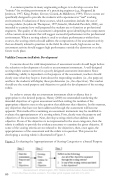
In order to ensure that an assessment instrument elicits evidence that is appropriate to the desired purpose, Hanny (2000) recommended numbering the intended objectives of a given assessment and then writing the number of the appropriate objective next to the question that addresses that objective. In this manner, any objectives that have not been addressed through the assessment will become apparent. This method for examining an assessment instrument may be modified to evaluate the appropriateness of a scoring rubric. First, clearly state the purpose and objectives of the assessment. Next, develop scoring criteria that address each objective. If one of the objectives is not represented in the score categories, then the rubric is unlikely to provide the evidence necessary to examine the given objective. If some of the scoring criteria are not related to the objectives, then, once again, the appropriateness of the assessment and the rubric is in question. This process for developing a scoring rubric is illustrated in Figure 3.
Figure 3. Evaluating the Appropriateness of Scoring Categories to a Stated Purpose
Rudner, L. and W. Schafer (2002) What Teachers Need to Know About Assessment. Washington, DC: National Education Association.
From the free on-line version. To order print copies call 800 229-4200
80


