


Page 84 - Loomis Annual Report 2017
P. 84
80
Notes – Group
Loomis Annual Report 2017
Note 6 cont.
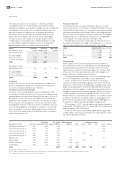
The table below presents an analysis of the Group’s  nan-
cial liabilities and net-settled derivative instruments compris- ing  nancial liabilities speci ed according to the time remaining from balance sheet date to the contractual maturity date. The amounts stated in the table are the contractual discounted cash  ows which are the same as nominal liabilities, as the bank loans have variable interest rates and credit margins
are assessed to be the same as would be obtained with a re- nancing on closing date. The commercial papers issued are classi ed as long-term liabilities since the commercial paper program requires a long-term back-up facility.
Financial credit risk
The Group has policies in place limiting the amount of credit exposure allowed to exist with any one  nancial institution or other counterparty. To limit credit risks, transactions take place primarily with  nancial institutions with a high of cial credit rating and with whom Loomis has a long-term customer relationship. The largest weighted exposure for all  nancial instruments to a single bank on the balance sheet date was SEK 165 million (99).
The table below shows the credit values of  nancial assets on the balance sheet date according to Standard & Poor’s or accord- ing to a similar rating institute with equivalent credit ratings:
Dec 31, 2017
49
593
275
917
SEK m
December 31, 2017
External bank loans
Accounts payable and other liabilities
(of which derivatives)
Total
December 31, 2016
External bank loans
Accounts payable and other liabilities
(of which derivatives)
Less than 1 year
553
1,512 (58)
Between 1 and 5 years
2,333 853
3,186
More than 5 years
801
– –
801
SEK m
A -1+
A -1
Other holdings Total
Financing risk
Dec 31, 2016
48 492 189 729
9
3,804
-
1,348
867
-
(-32)
-
-
1,358
4,671
-
Total 2,065
Credit risk
Financing risk is the risk that it will become more dif cult or more expensive to  nance outstanding loans. By maintaining a balanced maturity pro le for the Group’s loans, the  nanc- ing risk can be reduced. The Group’s goal is for no more than 25 percent of its total external loans and credit obligations to mature within the coming 12-month period.
All long-term  nancing and most of the short-term  nancing in 2017 were handled by Loomis AB’s treasury department.
In 2017 Loomis chose to exercise the option of a one-year extension of the  ve-year facility signed in June 2015. The facility amounts to USD 150 million, EUR 65 million and SEK 1 billion and funds can be withdrawn in USD, EUR, GDP and SEK. The facility will mature in 2022. In addition, Loomis has exercised the option to extend the syndicated loan that was signed in 2015 in the amount of SEK 500 million. The facility will mature in 2020. These credit facilities have the usual terms and conditions, one of which relates to a limit on the Group’s net debt in relation to operating income before interest, tax, depreciation and amortization (EBITDA). Loo- mis met this condition with a good margin throughout 2017.
On December 31, 2017, Loomis had issued commercial papers totaling SEK 1,850 million (500). The upper limit for the commercial paper program is SEK 3,000 million.
In 2014 Loomis launched an MTN program with an upper limit of SEK 3 billion. The total issued volume as of December 31, 2017 was SEK 1,000 million (1,550).
Credit risk is the risk of loss if a counterparty is unable to ful-  ll their commitments. Credit risk is divided into credit risk in accounts receivable and  nancial credit risk.
Credit risks in accounts receivable
The value of the outstanding accounts receivable was SEK 2,256 million (2,056). Any provisions for losses are made follow- ing individual assessment and totaled SEK 84 million (52) as of December 31, 2017. Accounts receivable do not include any signi cant concentrations of credit risks. The Group’s Contract Policy includes rules designed to ensure that customer credit management includes credit assessment, credit limits, decision levels and management of doubtful receivables to ensure that sales are made to customers with an appropriate creditworthi- ness. Further information about doubtful accounts receivables can be found in Note 22.
December 31, 2017
Syndicated loan facility 11) Syndicated loan facility 11) Syndicated loan facility 11) Syndicated loan facility 21) Syndicated loan facility 31) Bilateral loan
MTN program Commercial papers2) Credit facility
Total
The facility Currency amount (LOC m)
SEK 1,000 EUR 65 USD 150 USD 100 SEK 500 CHF 90 SEK 1,000 SEK 1,850 SEK 210
The facility amount (SEK m)
1,000 640 1,230 820 500 757 1,000 1,850 210
8,007
Utilized amount (SEK m)
–
– 205 – – 757 1,000 1,850 –
3,812
2018 2019
– – – – – – – 820 – – – – -- 1,000
1,850 – 210 –
2,060 1,820
Maturity structure 3) 2020 2021
2022 2023+
1,000 – 640 – 1,230 – – – – – 757 – – – – – – –
3,627 –
– – – – – – – –
500 – – – – – – – – –
500 –
1) Revolving credit facility ‘‘RCF’’.
2) The commercial paper program has long-term credit facilities as a back-up and is therefore classi ed as long-term in the balance sheet. 3) The maturity analysis presents the total facility in SEK million.


