


Page 70 - Australian Photography - September 2017
P. 70
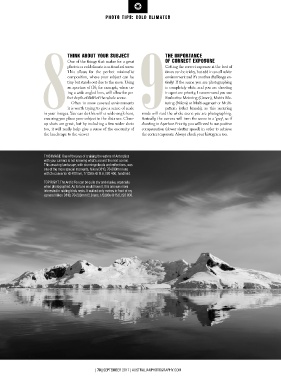
PHOTO TIPS: COLD CLIMAT ES


                    89                                                    THE IMPORTANCE


                               THINK ABOUT YOUR SUBJECT
                                                                          OF CORRECT EXPOSURE
                               One of the things that makes for a great
                               photo in a cold climate is untouched snow.
                                                                          Getting the correct exposure at the best of
                                                                          times can be tricky, but add in an all white
                               This allows for the perfect minimalist
                                                                          environment and it’s another challenge en-
                               composition, where your subject can be
                               tiny but stands out due to the snow. Using
                                                                          tirely! If the scene you are photographing
                                                                          is completely white and you are shooting
                               an aperture of f16, for example, when us-
                               ing a wide-angled lens, will allow for per-
                                                                          in aperture priority, I recommend you use
                                                                          Evaluative Metering (Canon), Matrix Me-
                               fect depth-of-field of the whole scene.
                                 Often in snow covered environments
                                                                          tering (Nikon) or Multi-segment or Multi-
                                                                          pattern (other brands), as this metering
                               it is worth trying to give a sense of scale
                     in your images. You can do this with a wide-angle lens,   mode will read the whole scene you are photographing.
                     ensuring you place your subject in the distance. Close-  Basically, the camera will turn the scene to a ‘grey’, so if
                     up shots are great, but by including a few wider shots   shooting in Aperture Priority, you will need to use positive
                     too, it will really help give a sense of the enormity of   compensation (slower shutter speed) in order to achieve
                     the landscape to the viewer                the correct exposure. Always check your histogram too.

                     THIS IMAGE: One of the joys of cruising the waters of Antarctica
                     with your camera is not knowing what’s around the next corner.
                     This amazing landscape, with stunning clouds and reflections, was
                     one of the more special moments. Nikon D810, 70-200mm lens
                     with 2x convertor @ 400mm, 1/1250s @ f5.6, ISO 400, handheld.
                     TOP RIGHT: The Arctic Fox can be quite shy and elusive, especially
                     when photographed. As fortune would have it, this one was more
                     interested in raiding birds nests. It walked only metres in front of my
                     camera! Nikon D810, 70-200mm f2.8 lens, 1/5000s @ f5.6, ISO 800.


                                            | 70 | SEPTEMBER 2017 | AUSTRALIANPHOTOGRAPHY.COM

