


Page 11 - 2026 Nonprofit Industry Trends
P. 11
9                                                                                                                                                                  10


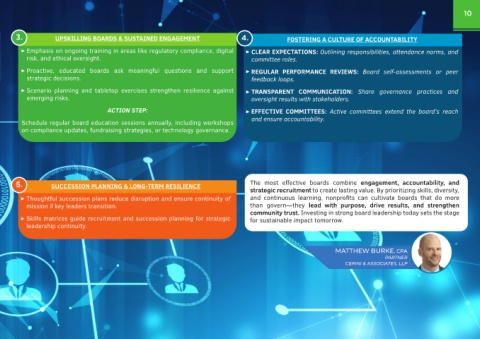
 ACTIVE, ACCOUNTABLE, AND IMPACTFUL:    3. ►  Emphasis on ongoing training in areas like regulatory compliance, digital   4.  CLEAR EXPECTATIONS: Outlining responsibilities, attendance norms, and
                    UPSKILLING BOARDS & SUSTAINED ENGAGEMENT
                                                                                                      FOSTERING A CULTURE OF ACCOUNTABILITY
                                                                                       ►
 BOARD LEADERSHIP TRENDS FOR 2026  ►  risk, and ethical oversight.                       committee roles.
          Proactive,  educated  boards  ask  meaningful  questions  and  support
          strategic decisions.                                                         ► REGULAR PERFORMANCE REVIEWS: Board self-assessments  or  peer
                                                                                         feedback loops.
        ►  Scenario  planning  and  tabletop  exercises  strengthen  resilience  against   ► TRANSPARENT COMMUNICATION:  Share governance practices and
 S  trong boards are no longer just a formality—they are strategic partners in driving mission success. In 2026, nonprofit boards are expected to be   emerging risks.  oversight results with stakeholders.
 more engaged, accountable, and forward-thinking than ever. From active oversight and committee participation to diverse recruitment that values   ACTION STEP:   ► EFFECTIVE  COMMITTEES:  Active  committees  extend  the  board’s  reach
 talent alongside financial contributions, today’s boards play a critical role in ensuring organizational resilience, transparency, and long-term impact.  and ensure accountability.
         Schedule regular board education sessions annually, including workshops
         on compliance updates, fundraising strategies, or technology governance.

 1.  ACTIVE, ACCOUNTABLE BOARDS DRIVE ORGANIZATIONAL SUCCESS  2.   BOARD RECRUITMENT: IT’S NOT JUST ABOUT THE MONEY


 ►  Boards are expected to go beyond compliance check-ins to actively monitor   ► Time, talent, and network matter just as much—if not more—than financial
 organizational performance, risk, and stakeholder trust.  contributions.

 ►  Clear  reporting  structures  such  as  dashboards  or  centralized  data   ► Board  members  bring  value  through  technical  expertise  (legal,  finance,   5.  SUCCESSION PLANNING & LONG-TERM RESILIENCE  The  most  effective  boards  combine  engagement, accountability, and
 repositories help boards ask the right questions and follow up on progress,   tech,  marketing),  community relationships, volunteer capacity, and   strategic recruitment to create lasting value. By prioritizing skills, diversity,
 reinforcing accountability and transparency.  mission-aligned passion.  ► Thoughtful succession plans reduce disruption and ensure continuity of   and  continuous  learning,  nonprofits  can  cultivate  boards  that  do  more

 BEST PRACTICE TIP:   ► Use a skills matrix to identify both current strengths and gaps, ensuring   mission if key leaders transition.  than  govern—they  lead with purpose,  drive results, and strengthen
                                                                                         community trust. Investing in strong board leadership today sets the stage
 each new member fills a strategic need.  ► Skills matrices guide recruitment and succession planning for strategic
 Introduce  formal  board  scorecards  or  quarterly  progress  reports  that            for sustainable impact tomorrow.
 measure  engagement  in  key  areas  like  governance,  fundraising follow-  RECRUITMENT BEST PRACTICES:   leadership continuity.
 through, committee activity, and strategic questioning.
 ✔ Map  board  skills  to  identify  gaps  (finance,  compliance,  fundraising,  IT,
 community ties).                                                                                                      MATTHEW BURKE, CPA
                                                                                                                                        PARTNER
 ✔ Engage existing members to identify  prospects  from professional  and                                                 CERINI & ASSOCIATES, LLP
 community networks.

 ✔ Prioritize diversity of perspective.

 ✔ Highlight  non-monetary contributions  like volunteer  leadership  and
 advocacy.

