


Page 4 - 2026 Nonprofit Industry Trends
P. 4
2026 ECONOMIC OUTLOOK:
MODERATE GROWTH IN A SHIFTING LANDSCAPE
3 4
KEY DRIVERS OF THE 2026 ECONOMY
THE STOCK MARKET
TECHNOLOGY AND AI INVESTMENT The Stock Market was strong in 2025, with the S&P growing by
approximately 18% for the year. For 2026, you should expect another
Investment in artificial intelligence, automation, and data centers remains year of gains, but most likely more modest at between 5 and 10%.
a significant driver of economic activity. Organizations across industries Growth will rely more heavily on corporate earnings rather than inflated
are continuing to deploy capital toward technologies that improve price earnings ratios, meaning growth will follow economic results,
efficiency, scalability, and long-term competitiveness. These investments favoring growth industries. Anticipated drops in interest rates should
are expected to support productivity growth, even as other sectors spur corporate spending and push more dollars into the market, driving
experience slower expansion. up stock prices.
MONETARY AND FISCAL POLICY CONSUMER SPENDING PRESSURES
Inflation, which has dropped during 2025 from highs of 3.0% to 2.6% Despite steady employment levels, many households continue to face
at year-end (its lowest since March of 2021) is expected to rise again rising costs in essential areas such as housing, healthcare, and food.
early in 2026, before settling down at about 2.4% by the 4th quarter of These pressures are expected to limit discretionary spending and
2026. Unemployment, which is hovering around 4.6% (a healthy level), contribute to uneven consumer demand, which may slow growth in certain
is expected to remain flat during 2026, with some minor declines by the sectors of the economy. Healthcare costs are leading the charge, with
end of the year. The flatting labor market is attributable to a slowing labor anticipated increases in healthcare spending in excess of 20%. Certain
supply (aging population and tighter immigration policies) offset by the ACA enhanced credits brought about by the American Rescue Plan and
impact of AI (potential job displacement with more expected with Tesla Inflation Reduction Act expired at the end of 2025. If Congress does not
robots to be released during 2026) and continued economic slowdown as renew these many lower income individuals will see significant increases
the Feds continue to look to curb inflation. in their healthcare premiums.
The current Fed interest rate is 3.5% to 3.75%. It is anticipated that POLICY AND TRADE UNCERTAINTY
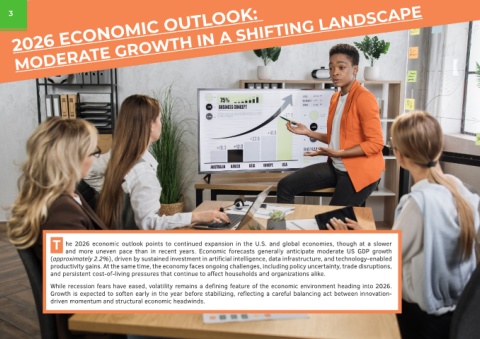
T he 2026 economic outlook points to continued expansion in the U.S. and global economies, though at a slower the Feds will drop that rate by the end of 2026 to 3.25% to 3.5%. Any Geopolitical dynamics and trade policy continue to introduce uncertainty
and more uneven pace than in recent years. Economic forecasts generally anticipate moderate US GDP growth decline in interest rates could stimulate borrowing and investment, but into the market. Shifts in tariffs, regulatory changes, and global supply
(approximately 2.2%), driven by sustained investment in artificial intelligence, data infrastructure, and technology-enabled the pace and timing remain uncertain and closely tied to labor market chain adjustments could impact pricing, investment decisions, and
productivity gains. At the same time, the economy faces ongoing challenges, including policy uncertainty, trade disruptions, conditions and inflation trends. Fiscal policy decisions will also play a long-term planning for organizations operating across borders. We do
and persistent cost-of-living pressures that continue to affect households and organizations alike. role, particularly in areas related to infrastructure, healthcare, and social anticipate a reduction in tariff impact during 2026, which should boost
services.
While recession fears have eased, volatility remains a defining feature of the economic environment heading into 2026. growth in both the United States and China.
Growth is expected to soften early in the year before stabilizing, reflecting a careful balancing act between innovation- CONTINUED ON NEXT PAGE
driven momentum and structural economic headwinds.

