


Page 44 - 2026 Nonprofit Industry Trends
P. 44
43                                                                                                                                                                                                                                                                                                                                       44


       As we look ahead to 2026, small and mid-sized nonprofits face a
       pivotal moment—balancing rising pressures with opportunities
       to modernize. These organizations continue to deliver essential
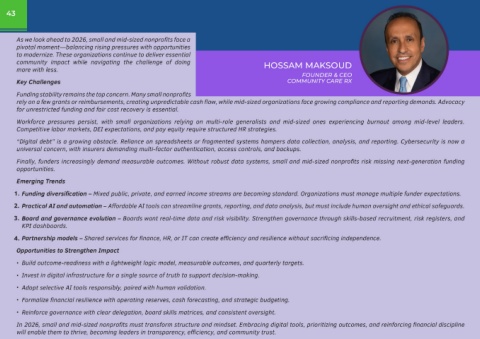
       community  impact while navigating the challenge of  doing                             HOSSAM MAKSOUD                                                                                                         MATTHEW THOMPSON                                                                              SUZETTE GORDON
       more with less.
                                                                                                           FOUNDER & CEO                                                                                             SENIOR VICE PRESIDENT                                                                         PRESIDENT & CEO
       Key Challenges                                                                                 COMMUNITY CARE RX                                                                                              MORGAN STANLEY                                                                                SCO FAMILY OF SERVICES
                                                                                                                                                                                                                     WEALTH MANAGEMENT
       Funding stability remains the top concern. Many small nonprofits
       rely on a few grants or reimbursements, creating unpredictable cash flow, while mid-sized organizations face growing compliance and reporting demands. Advocacy        Funding continues to be a recurring challenge for nonprofits. Organizations need to focus on    From our perspective as a human services agency, our biggest
       for unrestricted funding and fair cost recovery is essential.                                                                                                          funding differently. Government funding is increasingly challenging, requiring more efficiency   challenges include the impending cuts to Medicaid as a result of
                                                                                                                                                                              and  effectiveness  with  shrinking  dollars.  Corporate  funding  seeks  greater  impact  and   federal legislation, escalating insurance costs, and the ongoing
       Workforce  pressures  persist,  with  small  organizations  relying  on  multi-role  generalists  and  mid-sized  ones  experiencing  burnout  among  mid-level  leaders.
       Competitive labor markets, DEI expectations, and pay equity require structured HR strategies.                                                                          alignment, while foundation and donor funding faces more requests for the same amounts.         challenge of underfunded programs and how that impacts our
                                                                                                                                                                              Unsolicited requests are less likely to be considered and will continue to be overlooked.       ability to pay human services workers competitively. These
       “Digital debt” is a growing obstacle. Reliance on spreadsheets or fragmented systems hampers data collection, analysis, and reporting. Cybersecurity is now a                                                                                                          changes will impact organizations of every size, forcing them to
       universal concern, with insurers demanding multi-factor authentication, access controls, and backups.                                                                  This  backdrop  requires  agencies  to  revisit  operations  to  optimize  effectiveness  and   be agile and engage in scenario planning to mitigate the changes
                                                                                                                                                                              establish  internal  metrics  to  communicate  with  funders.  Significant  corporate  employee   in the external landscape on the organization.
       Finally, funders increasingly demand measurable outcomes. Without robust data systems, small and mid-sized nonprofits risk missing next-generation funding             engagement should be part of a nonprofit’s mission, as corporate funds without engagement
       opportunities.                                                                                                                                                         are increasingly unlikely. Historical foundation and donor support is aging, and the next       Because  many  nonprofits  face  the  same  challenges,  it  will  be
                                                                                                                                                                              generation is directing resources to organizations aligned with their priorities. Nonprofits    important to collaborate and advocate for policies that mitigate
       Emerging Trends                                                                                                                                                        should have leadership and board-level conversations to determine what can be implemented       some of the challenges we see on the horizon. New York State
      1.  Funding diversification – Mixed public, private, and earned income streams are becoming standard. Organizations must manage multiple funder expectations.           and what future funding is at risk.                                                             has an opportunity to soften the impact of federal Medicaid
                                                                                                                                                                                                                                                                              changes to ensure that the most vulnerable among us are not
      2.  Practical AI and automation – Affordable AI tools can streamline grants, reporting, and data analysis, but must include human oversight and ethical safeguards.     Technology also needs focus, particularly utilization rates. Many organizations do not track    left without healthcare. Nonprofits should prepare to advocate
                                                                                                                                                                              the use of services, programs, and benefits offered. Understanding utilization rates leads      for  their  clients,  make  decisions  driven  by  data,  and  actively
      3.  Board and governance evolution – Boards want real-time data and risk visibility. Strengthen governance through skills-based recruitment, risk registers, and        to  better  cost management  and resource  allocation. Organizations  should  challenge  the    engage in strategic contingency planning so they are prepared
         KPI dashboards.                                                                                                                                                      premise of “we’ve always done it this way” and focus on offering services and programs          for any changes in the landscape.
                                                                                                                                                                              that reach the most people and create the greatest impact. Communicating these metrics
      4.  Partnership models – Shared services for finance, HR, or IT can create efficiency and resilience without sacrificing independence.                                  can grow future funding opportunities, as few organizations provide this level of insight.

       Opportunities to Strengthen Impact                                                                                                                                     Utilization tracking should extend beyond programs to the entire organization.

       •  Build outcome-readiness with a lightweight logic model, measurable outcomes, and quarterly targets.                                                                 Board engagement remains critical.  Reengaging  board members is often overlooked but
                                                                                                                                                                              essential.  Boards generally set the benchmark for organizational support:  sourcing new
       •  Invest in digital infrastructure for a single source of truth to support decision-making.                                                                           members, attending meetings, and providing financial contributions. Organizations with low
                                                                                                                                                                              engagement often see limited donor support. Everything starts with the board—changing
       •  Adopt selective AI tools responsibly, paired with human validation.                                                                                                 how the board functions can transform how the organization functions. Stepping back to

       •  Formalize financial resilience with operating reserves, cash forecasting, and strategic budgeting.                                                                  evaluate board roles can enable greater progress moving forward.

       •  Reinforce governance with clear delegation, board skills matrices, and consistent oversight.
       In 2026, small and mid-sized nonprofits must transform structure and mindset. Embracing digital tools, prioritizing outcomes, and reinforcing financial discipline
       will enable them to thrive, becoming leaders in transparency, efficiency, and community trust.

